
|
Disney et al. v. MiniMax & Hailuo AI: No Sacred Cows, No Legal Remedy
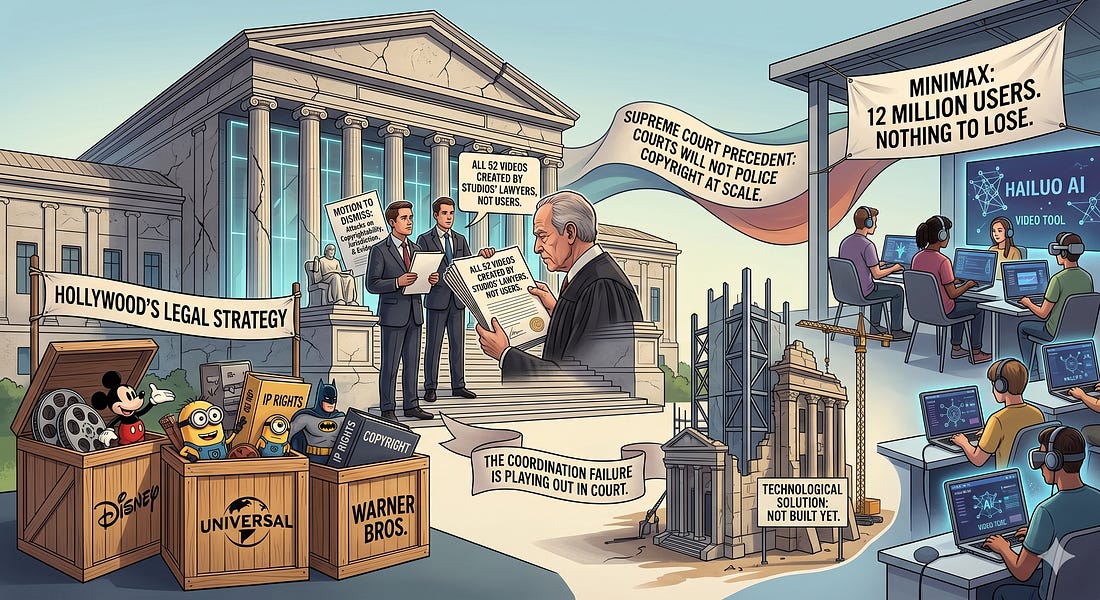
MiniMax's motion to dismiss confirms what Cox v. Sony signaled: the legal system will not protect Hollywood's IP at scale. The studios need a technological solution they have not built yet.
| |||||||||||||||


The lawyers for Nanonoble, MiniMax and Shanghai Xiyu Jizhi Technology (“SXJT”) just brought two motions to dismiss a lawsuit filed last fall by Disney, Universal, Warner Bros., and a host of other affiliated studios (including Marvel Characters, Lucasfilm, Twentieth Century Fox, DreamWorks, and Turner Entertainment). Shanghai Xiyu Jizhi Technology Co. Ltd. (SXJT) is the parent company of The MiniMax Group, Inc.—a publicly listed company on the Hong Kong Stock Exchange—and its Singapore-based “sister entity” NanoNoble.
Nanonoble is the sole operator of the version of Hailuo AI available to users in the United States. The lawsuit alleges that MiniMax, Nanonoble and SXJT disregarded U.S. copyright law by treating the studios’ copyrighted characters as if those were their own.
A motion to dismiss is, at its simplest, an argument for an outcome. As a rule, outcomes are determinative and arguments are not. In this case, this argument makes a number of counterpoints that mirror themes in my recent essays:
Cox Communications v. Sony Music Entertainment told IP holders that the legal system is the wrong venue for solving this problem at scale and that is the overall gist of the filing;
The 52 infringing videos were created by the studios themselves and not by any creators, which fails the Cox Commc’ns, Inc. v. Sony Music Ent. test of a service provider being secondarily liable
The studios may own popular IP like “Star Wars” but their complaint fails to explain why their copyright registrations also cover the characters within them—suggesting that there are “no sacred cows”;
U.S. copyright law does not reach conduct that occurred entirely abroad, suggesting Hailuo AI is one of those “thousands of tools” like Sora but which cannot be sued.
More importantly, the motion to dismiss also confirms the market coordination failure I highlighted last month with my Beer Marketplace paradigm: MiniMax and NanoNoble are arguing that they are neither able nor incentivized to police copyright the way the studios want both within and outside the U.S. The law is not the solution here.
 |
Past essays related to today’s analysis:
 |
|
