
|
A Map Through Natural Theology
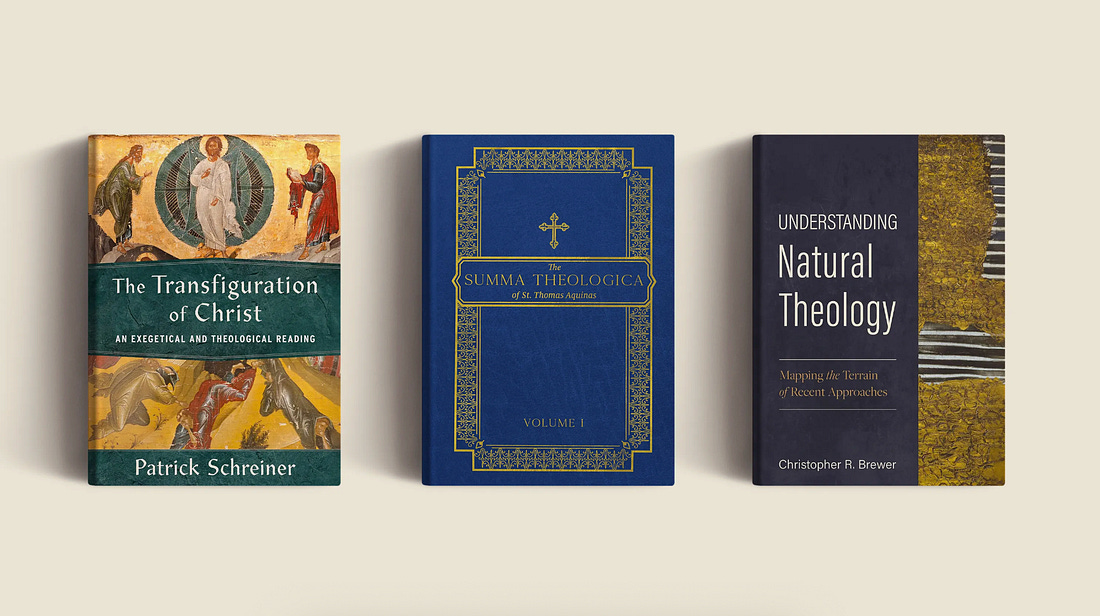
Three theology books on natural theology, the transfiguration of Christ, and a classic must-read.
| |||||||||||||||


 |
One of my favorite parts of having topic experts review books in their fields for this newsletter is that it helps us laypeople understand how to approach certain types of texts. Today, pastor theologian Andrew Wilson offers a case example. He reviews Christopher Brewer’s new book on natural theology and why it’s “part one” of a theological treatise. Then he shows us why Patrick Schreiner’s 2024 exposition of the transfiguration of Christ is done so well. Finally, he reminds why Thomas Aquinas’s greatest work still stands today—and is worth taking the time to read.
Happy Reading,
Kara Bettis Carvalho
Senior Features Editor, Christianity Today
P.S. A portion of this newsletter appeared as a column at Christianity Today. Join CT for full access to all our journalism.

 |
Three Books on Theology
Christopher R. Brewer, Understanding Natural Theology: Mapping the Terrain of Recent Approaches (Zondervan Academic, 2026)
Works of academic theology often proceed in two parts. Part one clears the ground: It defines key terms, narrates the history of the subject, offers a survey of contemporary debates, and enters into dialogue with a handful of influential interpreters. Part two, which may or may not come in a separate volume, offers the author’s constructive proposal. If done well, the two parts fit neatly together and move seamlessly from problem to solution.
The tragedy of Understanding Natural Theology is that Christopher R. Brewer was diagnosed with terminal brain cancer at the end of part one. As a result, we have his critical appraisal but not his constructive proposal. This leaves us, as the subtitle makes clear, with a map of the current terrain but without a recommended path through it.
The map is detailed and thoughtfully presented. Brewer outlines five views on natural theology in two chapters each: natural theology as (1) informed by natural religion, (2) as proof or argument for God, (3) as signal of transcendence, (4) as Christian natural theology, and (5) as a theology of nature. The key modern thinkers are all there, from Alvin Plantinga and Stephen Evans to Thomas Torrance and Karl Barth. But after sifting through all the definitions, debates, jargon (including “Realdialektik,” “metaxological”), and throat-clearing (“There is, in an important sense, no such thing as ‘natural theology’ but instead only ‘natural theologies’”), the reader wants a path, or at least a guide. Brewer’s untimely death leaves us without it.
Happily, however, we are given a sketch of one. In a brief afterword, Brewer suggests replacing Augustine’s famous “two books” analogy—God reveals himself through his Word and his world—with Gérard Genette’s metaphor of text and paratext. The book of nature is paratextual, like the hallway or vestibule through which we enter the “house” of God’s Word. It “precedes, accompanies, and mediates the text” of Scripture. It would be fascinating to see another theologian pick up this metaphor and write the equivalent of Brewer’s part two.
Patrick Schreiner, The Transfiguration of Christ: An Exegetical and Theological Reading (Baker Academic, 2024).
At its best, exegetical theology is thrilling. If the subject matter is captivating, the exegesis faithful, and the theology both fresh and orthodox, then the results can be exhilarating, fueling worship and wonder in the reader. All of those things are true of The Transfiguration of Christ. Few scenes in Scripture are more theologically weighty than the Transfiguration, and in few cases are the details more suggestive and the interpreter’s work more intriguing. Patrick Schreiner makes the most of this.