|
|
|
|
|
|
|
|
|
The Home of the Week is a renovated Prince Edward County farmhouse that only looks typical from the outside. Dan Fleury Photography
|
|
|
|
|
This week: CREA cut its home sales and price predictions as war weighs on the market, and our real estate and personal finance reporters answered your questions about whether now is a good time to buy or sell. Plus, the number of first-time buyers co-signing mortgages with their parents has surged, and one property worth a look. |
|
|
|
|
|
|
|
|
|
|
How to know if it’s the right time to buy or sell a home |
|
|
|
|
|
|
|
|
|
|
|
|
|
Our experts answered your questions about how to time your purchase or sale amid economic turmoil and a frosty spring in the housing market. Isabella Falsetti/The Globe and Mail
|
|
|
|
|
If you’re on the fence about buying or selling right now, you’re not alone. The market slump isn’t new, but home prices are still out of reach for many Canadians and war in the Middle East is driving higher mortgage rates and economic uncertainty. |
|
|
|
|
|
|
|
|
|
|
The bottom line? Without the luxury of a crystal ball, there’s no way to predict the future, but there are strategies to avoid the pitfalls of waiting for the “perfect” moment that may never come. |
|
|
|
|
“The decline in prices is attracting some buyers who have been waiting on the sidelines. But the drop also deters house hunters who are hesitant to ‘catch a falling knife,’” Carolyn Ireland told one Globe reader. “That’s the paradox of a downward trend: The more prices slide, the more buyers wait for them to fall farther. Add to that economic uncertainty, volatile financial markets and the actions of our neighbour down south, and many buyers adopt a ‘wait-and-see’ psychology.” Read our reporters’ insights and advice here. |
|
|
|
|
|
|
|
|
|
|
CREA cuts home sales and price predictions as war weighs on market |
|
|
|
|
While 2026 was never expected to be a year of skyrocketing growth for home sales and prices, turmoil in the Middle East and higher mortgage rates has the Canadian Real Estate Association tempering its modest optimism
less than four months in. Year over year, home sales are now forecast to increase by just one per cent – down from 5.1 per cent – and the average home price will reach $688,955, a 1.5-per cent increase rather than the 2.8-per cent rise forecast in January. |
|
|
|
|
Both of these are the best-case scenarios, according to senior CREA economist Shaun Cathcart, and if the war drags on, it could reduce buyers’ confidence even further, Rachelle Younglai writes. The economic and oil shock of the war has been a major blow to the slumping real estate market’s hopes of bouncing back. New home sales in Ontario surged
in the first week of April after the federal and provincial government’s HST rebate took effect. But as Rachelle reports, it’s too soon to say whether the tax-break will lead to a sustained recovery. |
|
|
|
|
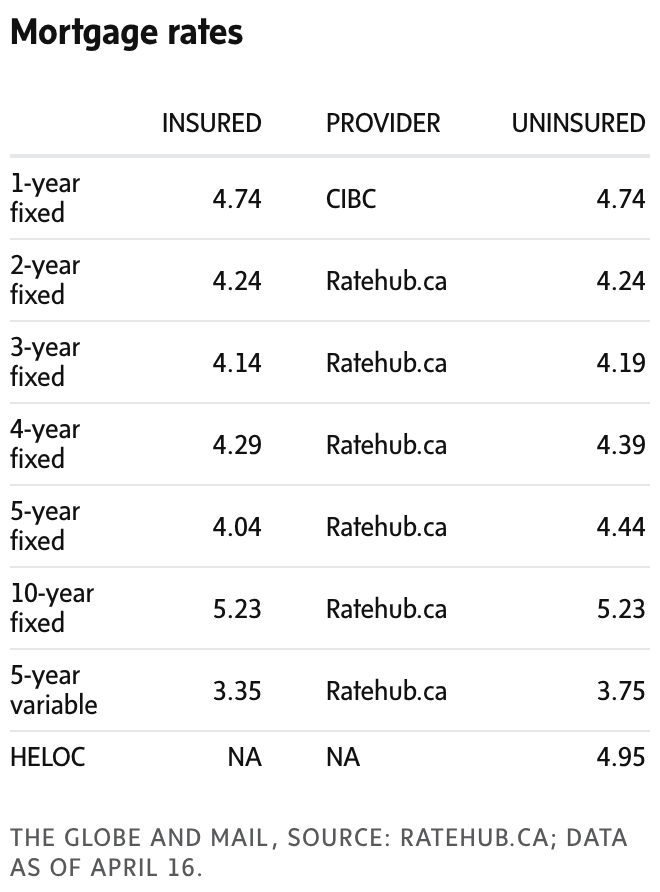
This week’s lowest fixed and variable mortgage rates in Canada |
|
|
|
|
|
|
|
|
|
|
|
|
|
|
|
|
|
|
More first-time homebuyers rely on parents to co-sign mortgages than ever before |
|
|
|
|
|
|
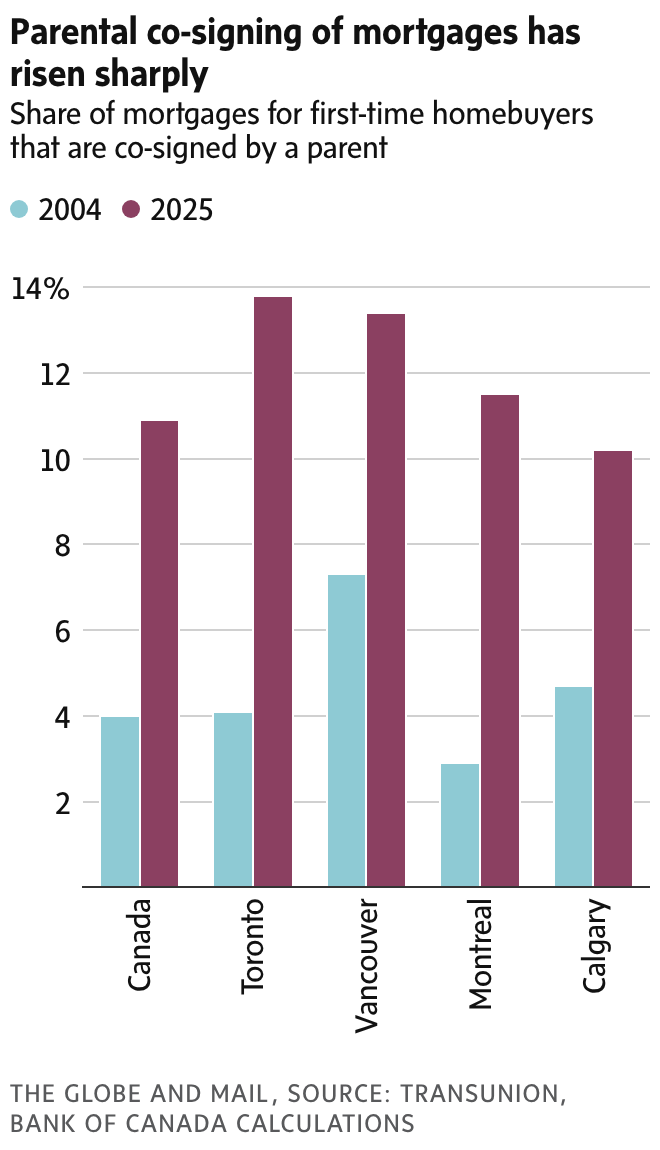
As a rising number of adults have been turning to the bank of mom and dad for help with their down payments, more and more parents have also been lending another kind of helping hand. Approximately 11 per cent of first-time buyers under 50 co-signed their mortgages with their parents in 2025, up from 4 per cent in 2004, according to new research
from the Bank of Canada. In Canada’s most expensive cities, Toronto and Vancouver, the co-signing rates are closer to 14 per cent, while Montreal saw the steepest increase from 2.9 to 11.5 per cent. |
|
|
|
|
With home prices vastly outpacing incomes in the last two decades, having parents on board dramatically increases your purchasing power, Jason Kirby reports. But there is a flipside: the more additional debt children took on to buy a home, the more likely they were to fail to repay credit cards and lines of credit later on. This puts both generations at a higher risk of financial troubles, according to BoC economist Shaoteng Li, and “may represent an emerging vulnerability for the financial system.” Take a closer look at the data and what it means for first-time buyers. |
|
|
|
|
|
|
|
|
|
|
Five tips to declutter family heirlooms guilt-free |
|
|
|
|
|
|
|
|
|
Alex Currie decided to keep only some of her grandparents' custom-built antique furniture when she bought their Calgary home, including the console table in the entryway. Michelle Johnson/Supplied
|
|
|
|
|
Whether you are preparing to downsize or sorting through a relative’s belongings after their death, deciding which family heirlooms to keep, sell or toss can be a difficult and emotional task. Sentimental value and re-sale potential often makes it hard to let go, even if you have limited space or the keepsakes don’t necessarily match your personal style. |
|
|
|
|
|
|
|
|
|
|
|
|