| | In today’s edition: We recap a jam-packed week of media news at Semafor World Economy.͏ ͏ ͏ ͏ ͏ ͏ |
| |  Washington Washington | New York |  San Francisco San Francisco |
 | Media |  |
| |
|
 - Twitch’s Clancy
- Versant’s Lazarus
- Condé’s Lynch
- Carter and LeBron
- FIFA’s Infantino
- Cloudflare’s Prince
- Mixed Signals
|
|
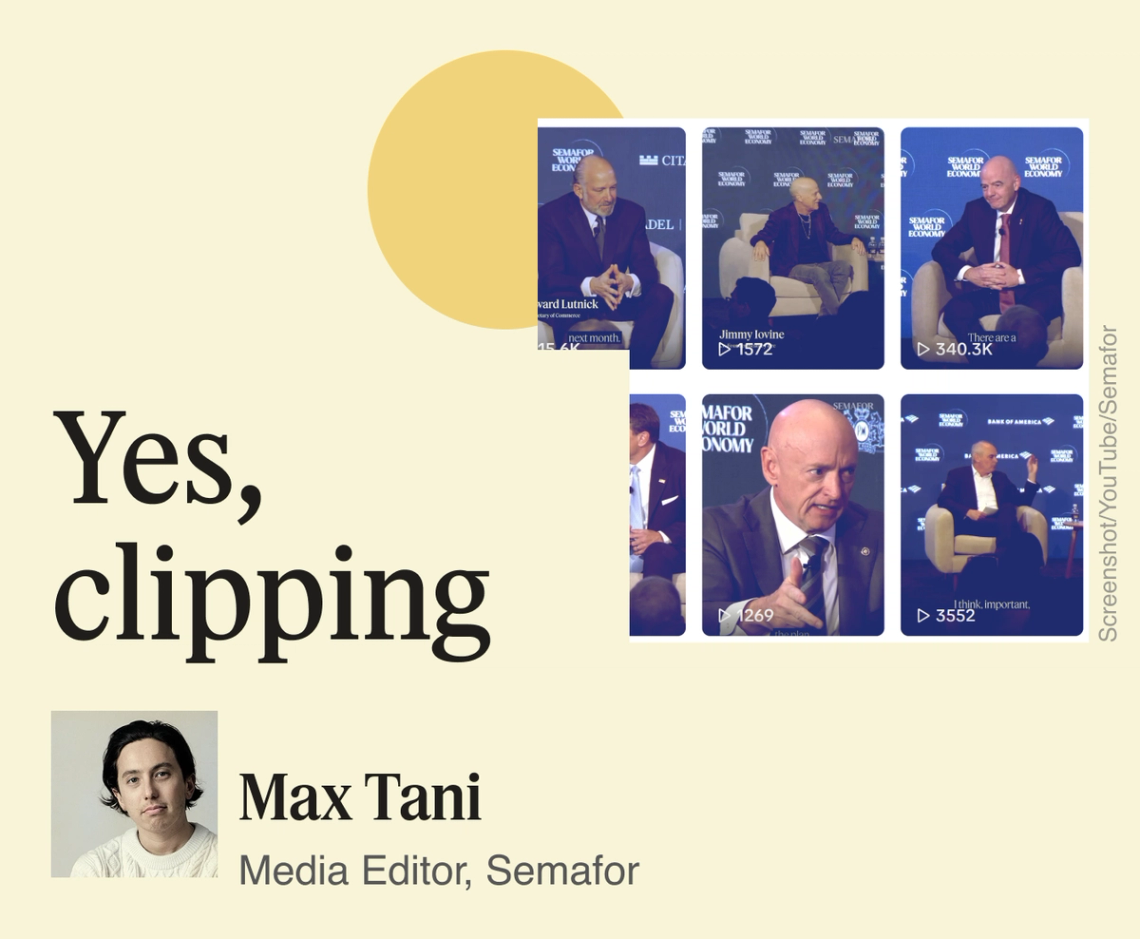 The media word of the year is “clipping.” Chopped-up hours of video content have become the primary food source of a modern media economy that revolves around vertical video feeds — and is increasingly being produced at industrial scale. No one seems to be able to stop talking about the leftist Twitch streamer Hasan Piker — despite the fact that, let’s be honest, most people talking about him have never tuned in to one of his (horizontal) livestreams. TBPN has partially justified its wild sale price by emphasizing how the views on its clips outstrip the modest audience for its livestreams. (Now the show’s fans are suspicious that since OpenAI bought TBPN, X is downranking the clips; when Semafor asked, OpenAI’s Chris Lehane didn’t answer.) Creating and distributing video clips online is hardly new. YouTube built a business worth hundreds of billions on video clips. Clipping changed sports media years ago, and transformed the way professional sports leagues thought about how fans were consuming the games. Mediaite, which we wrote about this week for different reasons, has essentially been clipping television content for its website for two decades. But now it’s an industry. Twitch CEO Dan Clancy told me onstage at Semafor World Economy on Thursday that the thing he’s most excited about is a product that will make clipping easier. The podcast platform Riverside has an AI tool that automatically suggests and creates clips of podcast moments; Mixed Signals producer Josh Billinson tells me it’s getting better by the week. It’s a consequence of AI’s growing strength at identifying news: For our convening last week, reporter J.D. Capelouto built us a new tool that analyzed the transcript of every panel, alerted individual journalists on Slack when terms/phrases/themes they’d asked to track came up, and showed where in the conversation the moment could be quickly pulled out … and clipped. For all their ubiquity, are any of those clips good or memorable? Not particularly, for the most part. But for the moment, clips seem like the format that the platforms and media companies and creators have agreed is cheap enough and interesting enough to keep people’s attention. Also today: We recap a jam-packed week of media news at Semafor World Economy. You can check out our conversations with a parade of top-tier media CEOs in full or in clipped format on YouTube (thanks, Josh!). |
|
Clancy on Twitch’s unique ‘community’ |
 Lexi Critchett/Semafor Lexi Critchett/SemaforDespite increasing competition in livestreaming, Clancy told Semafor he doesn’t worry about rivals like YouTube and TikTok. Twitch’s strength comes down to its community, Clancy said: Twitch measures engagement in hours, not seconds, and isn’t always enticing its users to “go somewhere else” by swiping up or clicking on a related video. That long time investment is something that Piker mentioned as unique to the platform in his conversation earlier this year on Mixed Signals, when he compared his fans to devoted listeners of Rush Limbaugh a generation ago. Clancy also said it’s what makes his platform a real “community”: There are trolls, yes, but they’re unlikely to stick around for an hours-long stream. “A lot of people talk about community in the online world, but I actually don’t think they use it right, because community is having a sense of belonging, and you get that by shared experiences,” Clancy said. Though Twitch has suspended Piker at times for inflammatory comments, Clancy defended keeping him on the platform on broad free-speech grounds. “One of the things that kind of works well on Twitch is if you don’t like what someone’s saying, then don’t go and listen to them,” he said. |
|
Lazarus pans political interference in dealmaking |
 Tasos Katopodis/Getty Images for Semafor Tasos Katopodis/Getty Images for SemaforWhen Semafor’s Ben Smith asked Versant CEO Mark Lazarus whether the Paramount-Warner Bros. Discovery merger is “going well,” he scoffed. But he lamented how the deal, which could see David Ellison’s company take over CNN, has been politicized in public. “I think the less politics involved in our businesses, the better,” Lazarus said. “I think whether it’s this administration or others, some take a point of view that government should be heavily involved in things, and some feel less so. I go with less so.” But if CNN does shift strongly rightward under its new ownership, that could widen the lane for Versant’s MS NOW. “We definitely have a network that leans democratic,” Lazarus said. “The wider the field is for us or the more open the field is for us to talk to an audience, I think that is better for us.” Lazarus also said that “62% of our viewership is live news and sports,” which the Versant CEO believes “helps drive our distribution and subscription revenue.” |
|
Lynch: No more magazine closures planned |
 Lexi Critchett/Semafor Lexi Critchett/SemaforHours after the news broke that Condé Nast was shuttering Self magazine, CEO Roger Lynch said at Semafor World Economy that he does not expect to close down any additional magazine brands this year. “For us, it’s really more about focus,” Lynch said. “I just want our teams really focused on the brands that really have a clear path to continued growth and profitability.” Lynch gave a positive assessment of the magazine giant’s prospects in China and the Middle East, despite ongoing geopolitical challenges, saying that lifestyle and luxury brands have done well in both regions. He added that the US market is very strong for the company’s magazine brands. One of those successes, Wired, has won acclaim since President Donald Trump’s second inauguration by aggressively covering politics and Big Tech, to the dismay of some titans of Silicon Valley. Lynch said he was comfortable with that confrontational coverage because the Newhouse family, Condé Nast’s owner, has taken a hands-off approach. “They do not interfere, which gives me as a CEO the ability to just appoint the best editors, let them do their jobs, and encourage them,” he said. |
|
Carter on what’s next for James |
 Kris Tripplaar/Semafor Kris Tripplaar/SemaforMaverick Carter, basketball great LeBron James’ longtime media partner and collaborator, said that changes in the tech and media landscape will allow James some flexibility in terms of his next moves once he retires (which could be as soon as later this month, though James hasn’t confirmed his plans). Fifteen or 20 years ago, Carter said, James’ primary option for remaining in the public eye would’ve been a career in sports broadcasting. Now, “we have a team of people that can produce and create at a high caliber,” Carter said. “So he is actually going to come to us with what his vision is. How does he want to keep creating content and telling stories that connect with his fans? And how do we build a suite of shows around that? And then the beauty of it is, today, distribution is everywhere. So someone like LeBron’s caliber is a big draw. You can get distribution anywhere and really connect with people and build a show, just us, without anybody else.” One of the primary focuses of their efforts, Carter told Semafor, would be continuing to grow Fulwell, the media and entertainment company he owns with James. He said Fulwell has a number of upcoming high-profile live projects in development, including the broadcast of the Grammys and the 2028 Olympics’ opening and closing ceremonies. |
|
FIFA’s Infantino on World Cup demand |
 Lexi Critchett/Semafor Lexi Critchett/SemaforFIFA President Gianni Infantino said Wednesday that some of the travel bans and stricter rules that the Trump administration has put in place should not affect the ability of fans to travel to the US to watch the World Cup, and said an expedited pathway for FIFA-related tourist visas “works actually quite well.” Some fans may still be hesitating: Hilton CEO Christopher Nassetta said at Semafor World Economy earlier in the week that hotel bookings in host cities were not “as strong as what we had hoped,” though he thinks more reservations will come closer to the game. Still, demand has been “unprecedented,” according to Infantino: The league got about 508 million ticket requests for the 6.5 million tickets for the 105 matches that will be played, he said. Infantino also made news by announcing that Coldplay will perform at the World Cup’s first-ever halftime show, and said the FIFA Peace Prize he’d given to Trump has proven popular (“a lot of people” want one of their own). |
|
Cloudflare CEO on AI’s promise for media |
 Tasos Katopodis/Getty Images for Semafor Tasos Katopodis/Getty Images for SemaforCloudflare CEO Matthew Prince said his experience owning The Park Record, a local Park City newspaper, has given him some insights into the future of media. He said he’d bought the paper to increase civic participation in the area, and pointed to increased voter turnout in recent elections since he purchased it. The paper has had some financial success by licensing its content to AI companies, which he said accounts for more revenue than digital advertising. Although he said “a whole bunch of existing media companies are about to just get crushed,” feeding credible journalism into AI models will improve the models and create greater financial incentives for those models to license journalism. “It would be amazing if The Washington Post covered not only what’s the best hotel in DC, but what’s the best hotel room in DC. Let’s get super-micro-granular to that. The nature of journalism has been: You have a certain number of column inches, you do all this work, and then it has to get reduced to this tiny amount. All those reporters’ notes, all that other information — that’s the most valuable stuff that you can be feeding into these things. Obviously, there are things you have to work through, but I think there’s an amazing way that we can actually be on the cusp of what is much better media going forward.” |
|
Patrick Radden Keefe on ‘Mixed Signals’ |
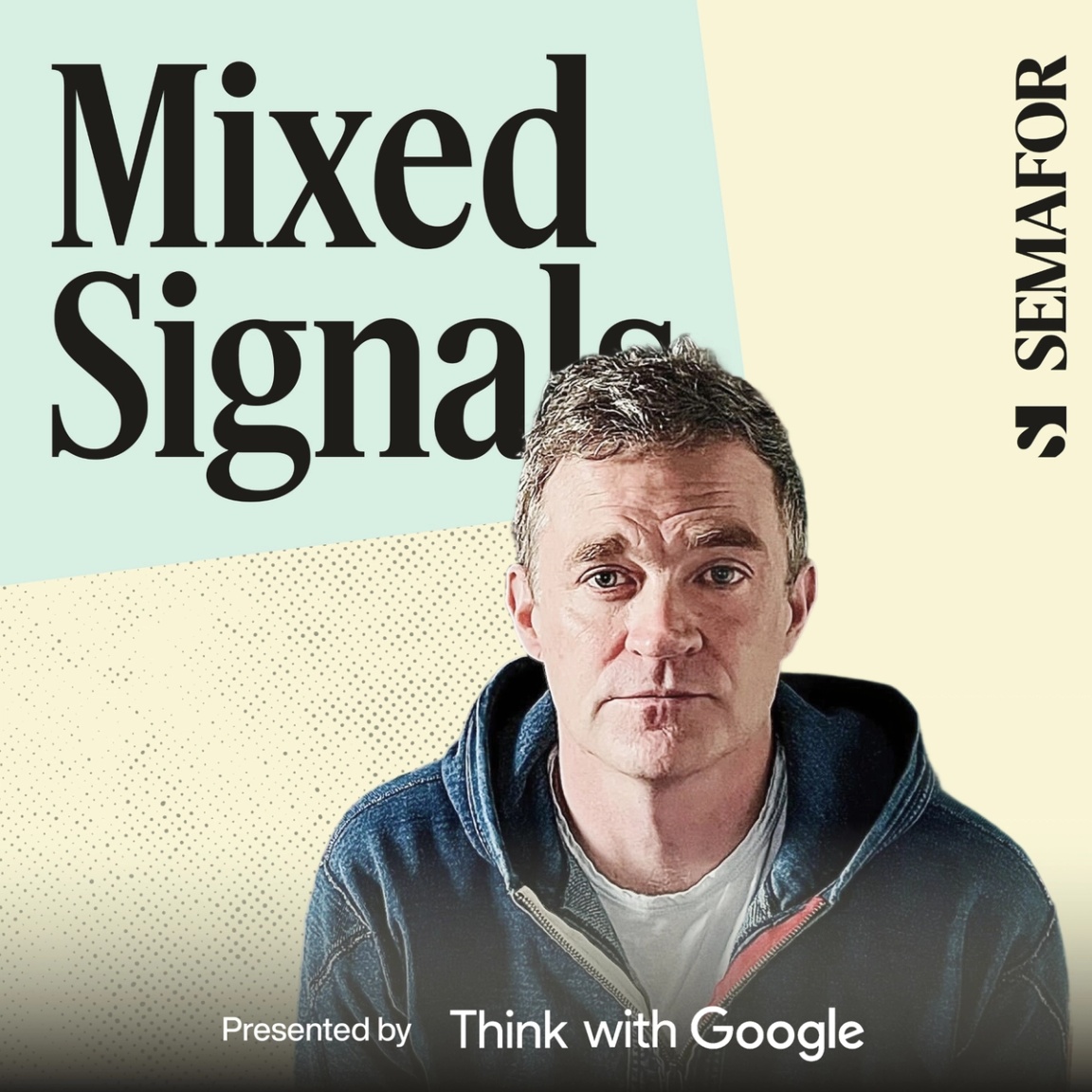 On this week’s Mixed Signals, Patrick Radden Keefe joins the show to talk about page-turning journalism, his own celebrity, and the humanity behind his work. Patrick discusses his new book, London Falling, how he finds stories that pull readers in, and the balance between mystery and resolution. He also touches on his unexpected celebrity, the shift from page to screen, and why real people and messy emotions make the best stories. |
|
|


