
|
This Supreme Court is wrecking our country
Its heartless rulings since Trump got his grubby little fingers on it are turning us into a nation of selfish, isolationist xenophobes.
| |||||||||||||||


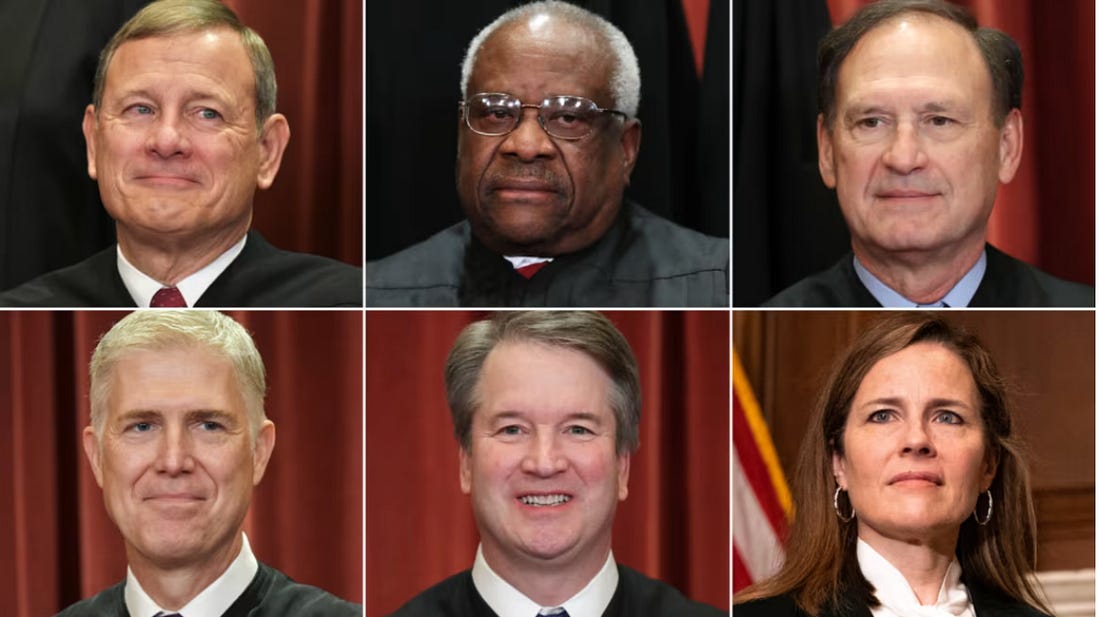 |
The Supreme Court’s conservative justices: Chief Justice John Roberts and Associate Justices Clarence Thomas, Samuel Alito, Neil Gorsuch, Brett Kavanaugh, and Amy Coney Barrett.
Hello — It’s International No Diet Day, aka every day in the United States. The sun rose in Boston at 5:32 a.m. and will set at 7:49 p.m. for 14 hours and 17 minutes of sunlight. The waning moon is 77% full.
The Old Farmer’s Almanac has a “historic” recipe for Needhams Potato Candy from the early 1900s and hey, I love mashed potatoes and I love chocolate, but it feels a little like putting acting AG Todd Blanche and the Constitution together. Aren’t really compatible.
⚖️ The lowest court in the land
So now Trump’s Republican-majority Supreme Court has further weakened the landmark Voting Rights Act — the court’s Democratic minority said they gutted it — and it’s remarkable just how much damage this conservative court has done to the basic notion of fairness that used to be a foundational element of our democracy and our society.
Take that Voting Rights Act, which Congress passed in 1965 to stop state and local governments that were blatantly creating laws and setting policies that made it difficult or impossible for Black residents to vote. Black citizens had the right to vote at the time, but Jim Crow laws in the South — things like poll taxes and literacy tests and land ownership and grandfather clauses — were used to prevent them from doing so.
The Voting Rights Act put a stop to all that. Over the years, Congress amended the Act five times to strengthen it — always on a bipartisan basis because both parties recognized that:
It was really effective in leveling the playing field for all voters.
Stopping racist, scheming politicians was the right thing to do.
Brennan Center: The Voting Rights Act, Explained
By the way, the Act was an astounding success. Black voter participation in elections and our democratic processes rose, more Black candidates were elected to political office, and if any state or county enacted a rule or law, or redistricted in such a way that made it harder for Black citizens to vote, they could be sued.
But there was another effect: Republicans realized that Black voters were choosing Democrats to represent them — Black and white. And they couldn’t have that. So they started chipping away at the Act.
The two most egregious attacks:
1. Shelby County v. Holder in 2013. The conservative justices destroyed Section 5 of the statute, which required states and counties that had made a sport of preventing Black people from casting ballots to get federal approval before changing their voting rules (called “preclearance”).
They ruled that the formula used to determine if a state or county should be subject to federal review was outdated, and besides — blatant discrimination against certain voters doesn’t exist anymore! (Clarence Thomas came up with that one.)
Hallelujah!
“Throwing out preclearance … is like throwing away your umbrella in a rainstorm because you are not getting wet.”
— Associate Justice Ruth Bader Ginsberg in her dissent
The result was pretty predictable. With the feds were no longer looking over their shoulder, Republicans worked furiously to stop Black and Latino voters again: Texas, Mississippi, Alabama, North Carolina, Louisiana, and other states acted quickly. Five years after the ruling, nearly 1,000 polling places had closed, most of them in counties that were predominantly Black. States and counties imposed strict forms of voter ID, purged voter rolls, reduced polling locations, required documentary proof of citizenship to register to vote, and cut early voting.
They even stopped Sunday voting, specifically to stop the “Souls to the Polls” initiative whereby many Black residents gathered after church and went to vote together. How low.
The suppression worked. Votes cast by Black citizens dropped by hundreds of thousands; the racial turnout gap increased.
Legal Defense Fund: How Shelby County v. Holder Broke Democracy
2. Louisiana v. Callais one week ago. Next on the chopping block was Section 2 of the Voting Rights Act, which bans voting practices that discriminate based on race, color, etc.
In 1982, Congress specifically amended the statute to make it perfectly clear that the discrimination didn’t have to be a deliberate, overt, invidious act with racist intent. Instead, if a voting change has the effect of denying a racial or language minority equal opportunity to participate in our electoral process, then it can be challenged.
Again, the number of Black members of Congress and elected officials around the country soared.
That also didn’t sit well with Republicans. They have wanted to make it extremely difficult for anyone to challenge discriminatory voting practices for a very long time, and proving intent is really, really difficult. So in a case in which Louisiana had gerrymandered a predominately Black congressional district out of existence, the conservatives on the Supreme Court obliged and usurped Congress’ legislative role.
In a decision released just last week, written by Samuel Alito and using tortured language to justify the action, the conservative majority ruled that voters who think they are being discriminated against do have to prove intent.
The effect? Very few, if any, challenges to things like racial gerrymandering will be successful.