
|
 |


In the wake of the Supreme Court’s decision effectively endorsing gerrymanders that disenfranchise Black voters, an outbreak of racism has spread through Southern state legislatures. Tennessee Republicans are pretending Black voters in Memphis don’t exist. Florida Republicans seem to have forgotten that Floridians voted to adopt a constitutional amendment banning both political and racial gerrymanders. And then, there’s Alabama.
Alabama has been at the center of the gerrymandering wars for years. In a surprise victory for Black voters, the Supreme Court ruled in their favor in a case known as Milligan. That case reached the Court after a three-judge panel in Birmingham unanimously concluded that it was not a “close” call whether the maps drawn by the legislature violated Section 2 of the Voting Rights Act, and barred the maps from being used.
The initial decision striking down the maps was authored by District Judge Anna Manasco, a Trump appointee. She was joined by another Trump appointee from Alabama, District Judge Terry Moorer, as well as Judge Stanley Marcus, a Reagan appointee to the Eleventh Circuit. You get the point: the maps were bad. They went beyond politics. They were about race.
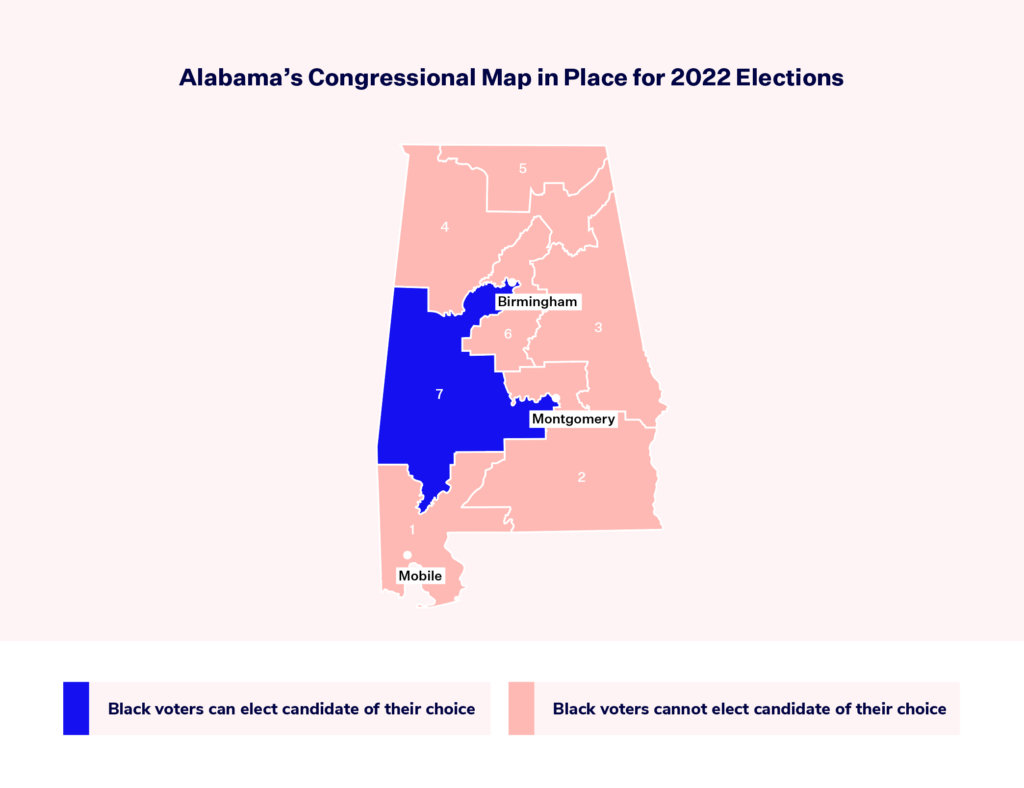 |
You can see it in the map itself: a little starfish with skinny arms reaching out to pull Black voters from Birmingham, Montgomery, and just north of Mobile into a single “packed” district, while the rest of Alabama’s Black population was “cracked” across the remaining six districts, leaving them with no meaningful opportunity to elect candidates of their choice. It was classic illegal gerrymandering. The Supreme Court agreed in an opinion authored by Chief Justice Roberts, who was joined by Justices Sotomayor, Kagan, and Jackson, and, on the key portion of the ruling that secured the victory for Black voters, by Justice Kavanaugh. The discriminatory map was struck down.
As you know from our discussion earlier this week, the Court previously delayed implementation of the new maps under Purcell, concluding that it was “too close” to the next election by the time it considered Alabama’s arguments. Alabama has seen the ups and the downs.
When the legislature finally began drawing new maps, it disregarded the Supreme Court’s order. Lawmakers produced a map that largely preserved the status quo, maintaining only a single Black opportunity district. The three-judge panel in Birmingham was not amused. “We are deeply troubled that the State enacted a map that the State readily admits does not provide the remedy we said federal law requires,” they wrote. The court removed the legislature from the mapmaking process and, after appointing a special master, assumed responsibility for drawing new maps that complied with the Voting Rights Act.
That is the history here. That is how Alabama finally ended up with maps containing a second Black opportunity district out of seven in a state where, according to the 2024 census, 26.5% of adults are Black. Another 4.7% percent of the population is multiracial or composed of other people of color, and 6% is Hispanic or Latino. The legislature refused to comply with the Supreme Court’s order, forcing the courts to do the job themselves.
What happened next, following the Callais decision, which effectively gave a green light to even the most racially discriminatory “political gerrymanders,” was entirely unsurprising: Alabama asked a federal court to allow it to return to the illegal racial gerrymander of its 2023 congressional maps. It took the state only a few days to get back into court.
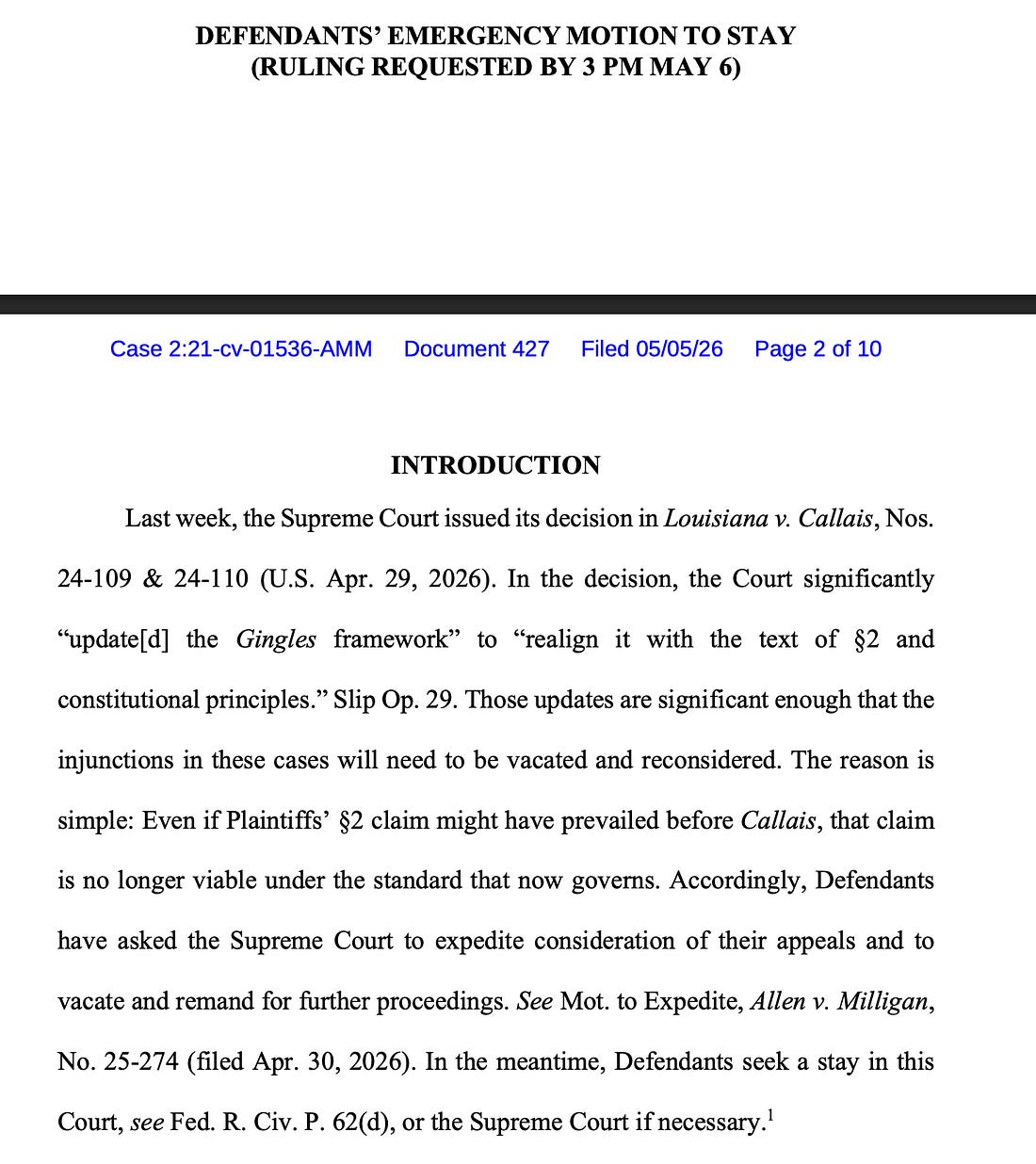 |
Alabama Attorney General Steve Marshall explained, “Defendants respectfully request a ruling quickly. Alabama is set to hold primary elections on May 19, and Governor Ivey has called the Alabama Legislature into a special session this week ‘to consider legislation to provide for a special primary election for electing members of the United States House of Representatives.’” Yet neither Purcell nor the principle underlying it—that courts should not change election rules too close to an election—was mentioned even once in Alabama’s 10-page motion. Not once.
Justices Kavanaugh and Alito relied on Purcell in 2022 when the Court required Alabama to use the same racist maps that the three-judge panel had already ruled illegal because it was supposedly too close to the election to change them. As Kavanaugh wrote:
That principle—known as the Purcell principle—reflects a bedrock tenet of election law: When an election is close at hand, the rules of the road must be clear and settled. Late judicial tinkering with election laws can lead to disruption and to unanticipated and unfair consequences for candidates, political parties, and voters, among others. It is one thing for a State on its own to toy with its election laws close to a State’s elections. But it is quite another thing for a federal court to swoop in and re-do a State’s election laws in the period close to an election.
Explaining his filing, Alabama’s Attorney General, who is running for the U.S. Senate, said, “It’s not our responsibility to create a minority party district so that somehow or another their voices can be heard,” he said. He said that Alabama’s legacy of slavery and racial discrimination, the issues that made it necessary to have a Voting Rights Act in the first place, are “no longer in play.”
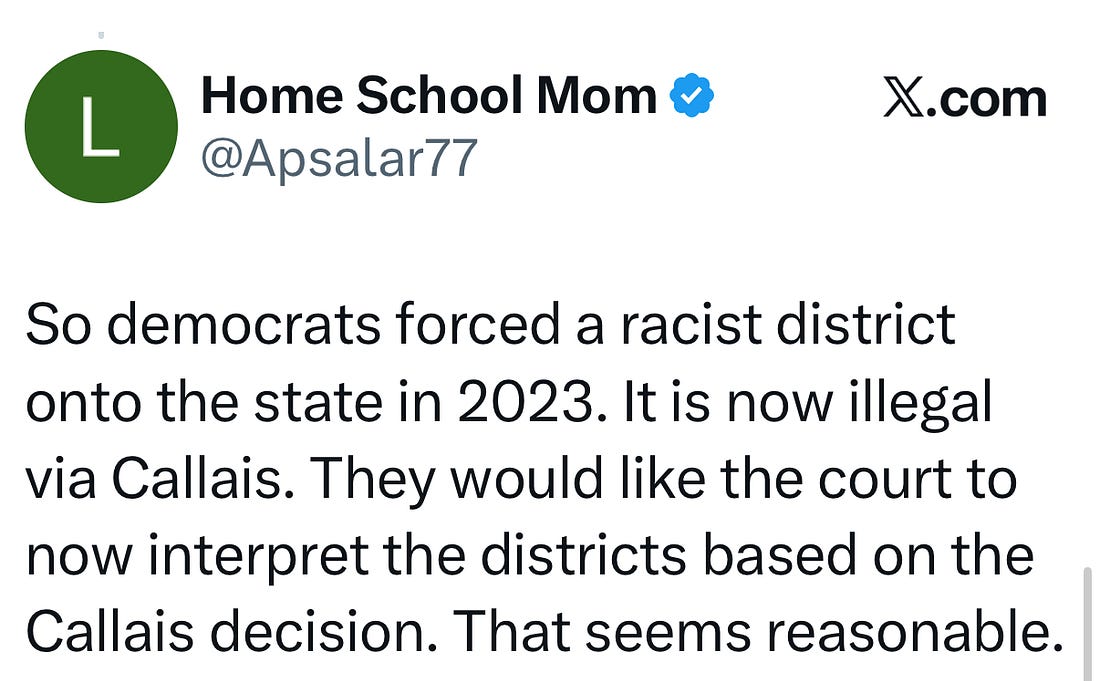
The MAGA hivemind got to work quickly. They too ignored the history that necessitated the Voting Rights Act, equating Alabama’s current maps, the ones the Supreme Court said were required by law, with discrimination against the white, Republican Voters, who currently hold five of Alabama's seven seats in the House of Representatives.
HomeSchoolMom on X explained that “democrats forced a racist district onto the state in 2023.”
 |
Damnocracy argued against the existence