
|


 |
PN is supported by paid subscribers. Become one ⬇️
When the Supreme Court smashed the last meaningful vestiges of the Voting Rights Act last week, it took literally a matter of hours before the reigning political powers in one state of the old Confederacy after another began moving to eliminate Black representation in Congress.
Louisiana, Alabama, Florida, and Tennessee all look like they’ll get rid of some or all of their substantially Black districts, and other Southern states could follow. There was no hesitation, no deliberation, and no doubt about it: If the Court is going to let them eliminate any chance for Black representatives to get elected from their states, they’re going to do it.
And that’s just Congress; with the VRA effectively overturned, many will likely redraw their state legislative maps to rid themselves of Black political influence as well.
 |
|
No one who observes the Court was surprised with the decision in Louisiana v. Callais, since destroying the VRA has been John Roberts’s goal since he was a young lawyer in the Reagan administration. But this is more than a tragedy for voting rights. It’s a kind of revival of the Confederacy, in a way that few liberals thought was possible. The Lost Cause doesn’t seem so lost anymore.
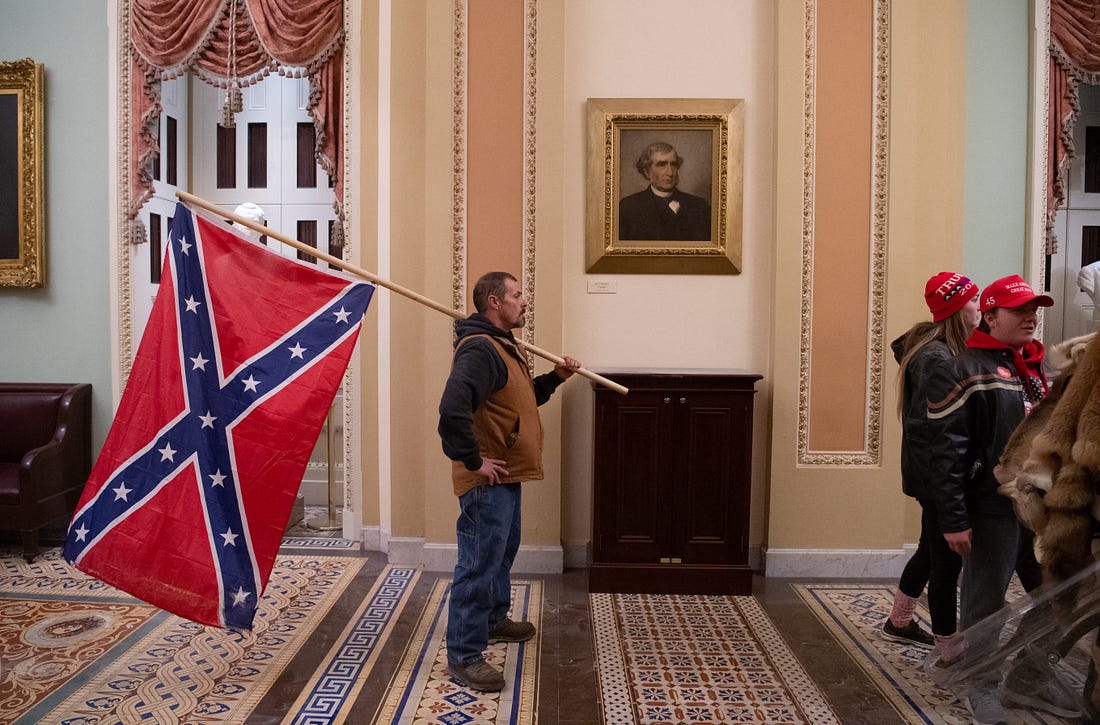
There has been a lot of liberal complacency about this in recent years, even as we decried Donald Trump’s promotion of the Confederacy and the ready audience it found on the right. Some of us were too quick to believe in a final cultural/political victory, confident that even as Republicans used their power to preserve emblems of the Confederacy and banish discussion of slavery and racism from schools, they were fighting a doomed rear-guard action. “The right has lost the debate over the Confederacy” read the headline on a piece yours truly wrote in 2021 after a statue of Robert E. Lee was taken down in Richmond.
But the truth is that this fight is far from over. The right never lost their faith that if they were patient and determined enough, the 1960s could be undone — and maybe some of the 1860s as well. They knew that even after a statue of a white supremacist slaveholding traitor is torn down, defeat is not permanent. In fact, that statue may literally be raised back up.
Never underestimate the power of right-wing backlash
The Civil Rights Era of the 1950s and 1960s is sometimes referred to as the Second Reconstruction, a moment when the high-minded promises of democracy written into the founding documents finally had legal force for everyone. And just as the first Reconstruction was followed by an intense and violent backlash that clawed back the political progress Black Americans had made across the South, the Second Reconstruction produced Richard Nixon and his “silent majority,” then the steady sorting of the two parties into a white conservative party and a multiracial liberal one.
But throughout those years and those that followed, it was possible to believe the arc of history was bending in only one direction. Republicans could trot out various race-baiting tactics at election time to great effect — Ronald Reagan’s “welfare queens,” George H.W. Bush and “Willie Horton” — but not only was legal equality reasonably secure, culture kept moving in a more progressive direction. Interracial couples became more common on TV and in movies, using racial slurs became less acceptable, and even conservative politicians had to pledge their commitment to an equal society. The VRA itself was repeatedly reauthorized and strengthened by wide bipartisan majorities in Congress.