
|


 |
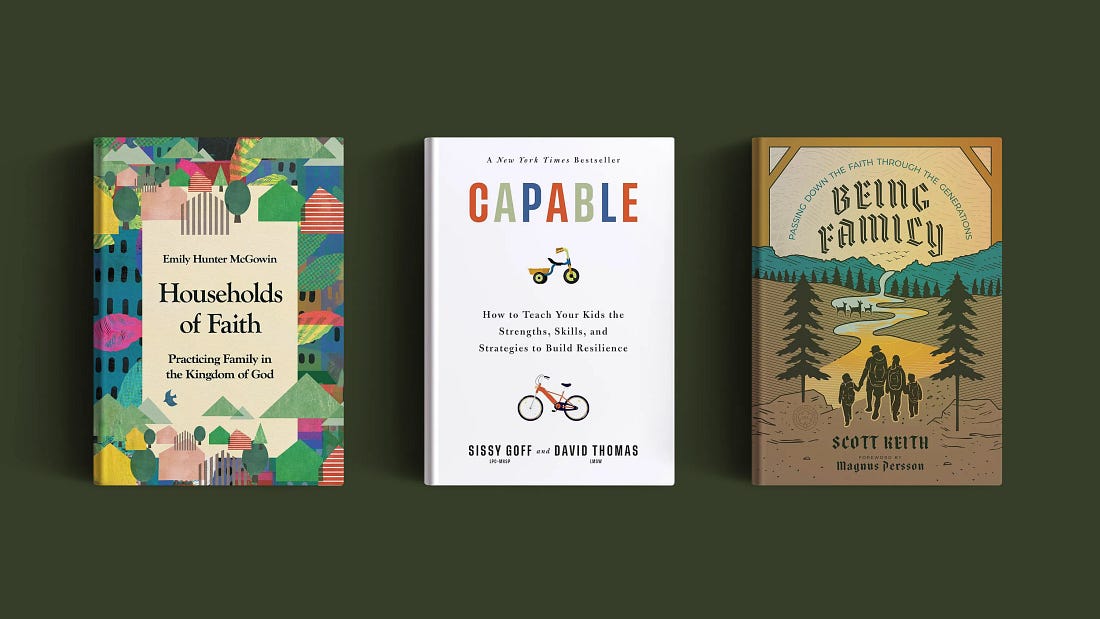
As a young 30-something, my current season of life has been marked watching many close, longtime friends welcome children into the world. In the past year, I’ve celebrated at least five births, with more arriving later this summer. It’s a joy to meet all these adorable babies and see my friends walk into this new season of parenting. In this week’s reviews, Gretchen Ronnevik takes a closer look at resources for young families. Capable addresses the difficulty of raising kids in our cultural moment, while Households of Faith and Being Family ask larger questions about what it means to be a family, both biblically and vocationally.
Happy Reading,
Taylor Berglund
Senior Features Editor, Christianity Today
A portion of this newsletter appeared as a column at Christianity Today. Join CT for full access to all our journalism.

 |
Three Books on Parenting & Family
Sissy Goff and David Thomas, Capable: How to Teach Your Kids the Strengths, Skills, and Strategies to Build Resilience (Bethany House, 2026)
In Capable, family therapists Sissy Goff and David Thomas observe the trend of today’s kids self-diagnosing their mental health status and rooting their identities in that. “I’m sad” has been replaced by “I’m depressed.” Rather than say they are “worried,” children now “have anxiety.” Instead of recognizing the normal human emotions they are experiencing, they stitch those emotions to their very identity, as though it were immovable and decided.
While children may feel incapable, Goff and Thomas found that parents are suffering too, often feeling like they don’t fully know their own children and are lacking confidence because of that. My own teacher and therapist friends have said that when kids are struggling, it quickly becomes apparent that the parents are often the ones who need help. Portions of this book reflect that reality. I appreciated that the book is written compassionately—not telling parents they’re doing it all wrong but rather reassuring them that they can trust their instincts as parents.
Depending on each parent’s background, fears and overcorrections can swing between neglectful and overreaching parenting, but the hope is to find a moderate approach. Each generation compensates for what they missed, and the pendulum often swings to the other side. The authors encourage parents to stop fearing theoretical pitfalls—based on their own childhoods—and instead see what the actual child before them needs. At times, Capable seems to be pleading with culture to let the kids learn the hard things they need to learn.
Goff and Thomas offer practical wisdom here for parents on when to step in, when to coach, and when to step back. They give “3 C’s” to develop in children: coping, competence, and challenges. Their model mirrors a phrase my husband and I have said in our own home filled with teens: “We need to allow them the dignity of working through a struggle.” The goal isn’t to remove obstacles but to use them as opportunities to overcome adversity and build skills. I also appreciated the authors speaking separately about the different developmental and cultural challenges boys and girls face when learning to become capable. It points again to the fact that parenting should be customized, not standardized.
Capable is very focused on developmental psychology, not theology, as it was written by Christian therapists rather than theologians. But the practical methods in here are incredibly helpful, and I wish I would have had this book years ago.
Emily Hunter McGowin, Households of Faith: Practicing Family in the Kingdom of God (InterVarsity Press, 2025)
In Households of Faith, Emily Hunter McGowin explores a holistic view of family based on the kingdom of God. I originally expected something more devotional, but I found that McGowin’s theologically academic approach challenged me to dig deep into the critical-thinking side of not just parenting but the concept of family. It had me reaching often for my Bible. While I don’t fully share the author’s egalitarian perspective, I immensely enjoyed engaging with several texts that were outside of the normal proof texts we often turn into b