| | In this edition: How Congress entrenched its own unpopularity, Midwestern progressives’ diverging fo͏ ͏ ͏ ͏ ͏ ͏ |
| |  SOUTHFIELD, MI SOUTHFIELD, MI | COLUMBIA, SC |  PORTLAND, ME PORTLAND, ME |
 | Americana |  |
| |
|
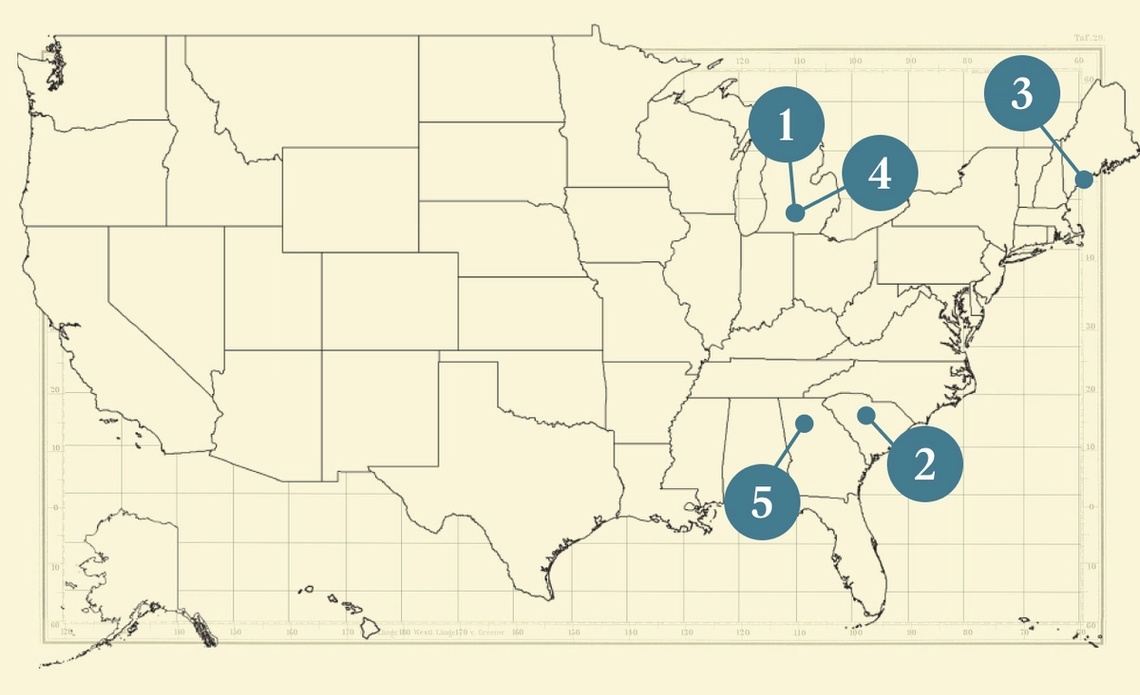 - Michigan vs. Wisconsin
- N.H. loses again
- Democrats’ nominee problems
- Michigan’s 7th, on the air
- Sweet in the Peach State
|
|
 When they’re not fighting each other, which is rare these days, Democrats agree on three points about their midterm election strategy. First, they want to talk about affordability. Second, they want to take on corruption. And lastly, the public perception that both parties are crooked makes it hard to talk about the second part. “My friends who aren’t politically engaged — I say, ‘Trump has made $4 billion since he’s been president, he’s getting a jet from Qatar,’” former Bernie Sanders and Joe Biden adviser Alex Jacquez told me at a progressive conference recently. “And they say, ‘Nancy Pelosi is long on Nvidia.’” Banning any stock trading by members of Congress is a wildly popular idea, in part thanks to individual lawmakers who made contradictory claims about their own bottom lines. But ironically, when Congress tried to rein itself in 14 years ago, its solution only strengthened the folk wisdom that many lawmakers are getting rich off insider information. The 2012 disclosure law known as the STOCK Act required members to report any trades made by them or their brokers within 30 days. Five years later, academic researchers found that the law had already been “effective in deterring politicians from exploiting their official positions for personal financial gains.” What the law didn’t do is dispel the impression that members of Congress are using their access to get rich. It ended up adding a political cost to following reporting requirements, which can generate bad headlines even without evidence that a lawmaker bought or sold stocks with knowledge he or she got from the Hill. “It did not achieve its design of increasing public confidence in Congress,” said Kedric Payne, the senior director for ethics at the Campaign Legal Center, of the 2012 STOCK Act. “But it did achieve its design of providing more transparency.” Members of Congress who simply file their paperwork late, an offense far short of insider trading, are hit by the same trust-sapping headline: They “violated the STOCK Act.” Those who set up blind trusts, as the 2012 law encourages, are on the hook if their brokers make money. |
|
Democratic swing-state debates treat progressives differently |
 Robin Buckson/Pool via Reuters Robin Buckson/Pool via ReutersMILWAUKEE — Democrats in two Midwest swing state debates this week took very different approaches to the left-wing candidates that Republicans consider easier to beat in November. On Monday night, Michigan Rep. Haley Stevens relentlessly attacked Abdul El-Sayed as a less electable candidate for Senate, with shady finances and unaffordable ideas. On Tuesday night, the four Wisconsin Democrats facing a socialist rival for governor didn’t attack her at all. Stevens accused El-Sayed of being a “celebrity candidate” who’d put a Democratic seat at risk, noting that she was endorsed by Gov. Gretchen Whitmer, whom El-Sayed had disrespected in the past. El-Sayed countered that Stevens’ votes for ICE funding and support from pro-Israel PACs were real liabilities: “If you need a $60 million crutch, you’re probably not that electable.” Tuesday night’s Democratic gubernatorial primary debate in Milwaukee had no such back-and-forths. When moderators pressed state legislator Francesca Hong on her old videos and tweets endorsing the abolition of police, Hong said that she would not defund police — and none of her four opponents followed up. They did so when the debate was over, telling reporters that the party risked losing if Hong became the nominee and Republicans could run against her prior views. “Getting rid of police departments entirely is something that is going to be tough,” said one of Hong’s rivals, former Lt. Gov. Mandela Barnes. While on stage, Barnes said only that he was leading the GOP in polls and other candidates weren’t. |
|
DNC primary calendar keeps S.C. as No. 1 |
 Leah Millis/Reuters Leah Millis/ReutersDemocrats’ decision to keep South Carolina first on their presidential primary schedule sets up another possible tussle with New Hampshire. South Carolina was pushed to first place for the 2024 primary, at Joe Biden’s request; New Hampshire held its primary first anyway, with Biden supporters organizing a write-in campaign for an event which no longer awarded delegates. It wasn’t a given that Democrats would keep that schedule, as Rep. James Clyburn asked only that his home state keep its place in the “first four” official primaries. But South Carolina remains first on the DNC-endorsed primary list. Nevada comes second on the new calendar; New Hampshire comes third; New Mexico fourth; then, Michigan and Virginia. |
|
Democratic hopes to boost independents get dashed |
 Amanda Sabga/Reuters Amanda Sabga/ReutersDemocratic dreams of nominating independent candidates in states where their brand is toxic keep hitting hurdles erected by Republicans. In Nebraska, where Democrat Cindy Burbank won the party’s Senate nomination with the intent of quitting to help independent candidate Dan Osborn, the loser of that nomination contest is now suing to force Democrats to pick a candidate. In Montana, Democrats have been surprised at the tenacity of Senate nominee Alani Bankhead, who reported less than $25,000 in her campaign account at the end of June. They’d seen her as likely to quit and clear a path for independent Seth Bodnar. But Bankhead has refused to leave the race: “I am never dropping out. Ever. Ever,” she said last month. Democrats got a break in Idaho, where the perennial candidate who won their nomination ended his campaign this week, a boost to independent Todd Achilles. But over in Maine, the Democratic candidate who wants to run is vulnerable to GOP challenges. The party has just named Troy Jackson its backup Senate nominee, even as a conservative legislator pushes the Maine secretary of state to disqualify him, citing state law that prevents “sore loser” candidates from seeking two different offices in the same cycle. (Jackson, along with the most credible contenders to replace Graham Platner, ran for governor this year and lost.) Read more from Burgess Everett about the Dems’ Montana problem. → |
|
|
The hits (and boosts) start coming for Maasdam in Michigan |
 Michigan Sunrise PAC Michigan Sunrise PACMichigan’s 7th Congressional District, which Americana readers visited last month, is the latest battlefield for super PAC meddling — and separate super PAC attempts to undo meddling. Michigan Sunrise PAC, the latest pop-up group that’s hiding its funders until after the primary is over, is attacking Democratic candidate and military veteran Matt Maasdam for being supported by “MAGA billionaires” (no source is provided for that claim) and hiding his identity as a former registered Republican in Florida (true). The PAC’s name is cheeky, since it conjures associations with Will Lawrence, the progressive candidate that Republicans think would be easier to beat; Lawrence cofounded the left-leaning climate group Sunrise Movement. On the pro-Maasdam side of the ad ledger is VoteVets, a super PAC that’s spent all cycle helping less left-wing candidates win primaries. It’s running a straight-to-camera spot from Sen. Elissa Slotkin, D-Mich., who talks about Maasdam’s work for then-President Barack Obama and promises that he’s not one of those Democrats “too weak to defend our democracy.” |
|
Ossoff and Lance Bottoms look good in latest pre-election polling |
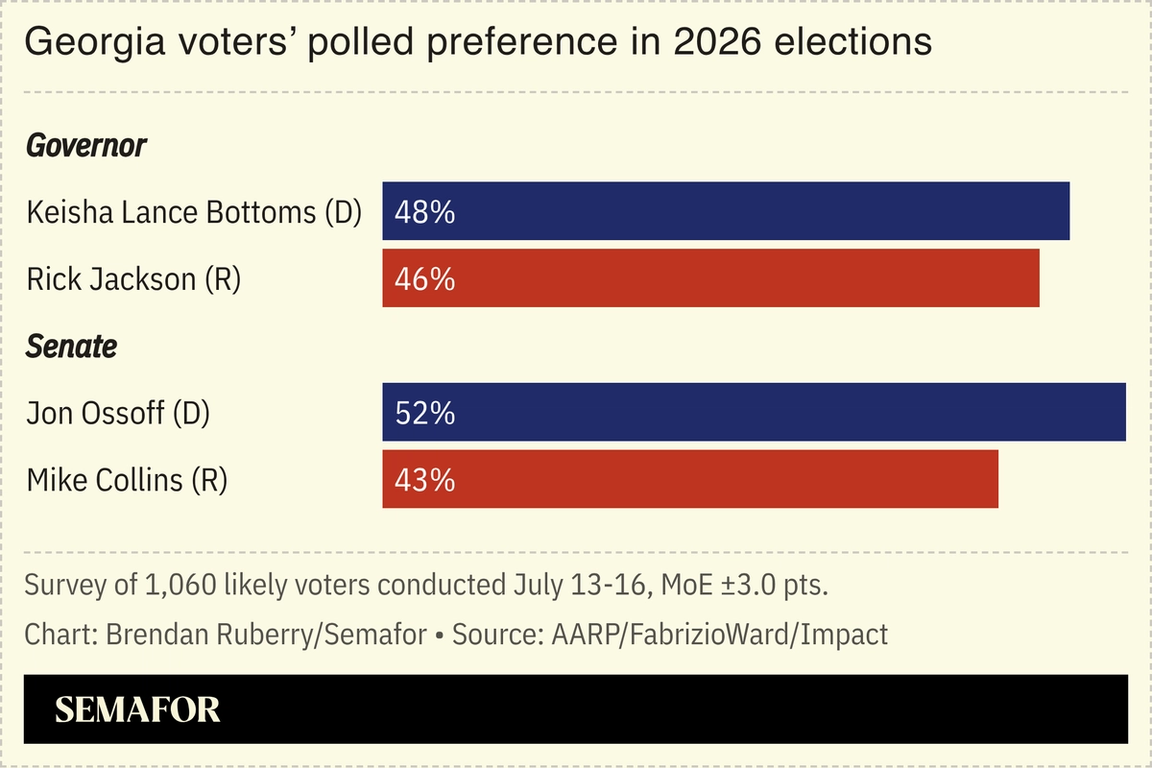 The Democrats’ unending Star Search for a 2028 savior has taken them to Georgia, where Sen. Jon Ossoff has impressed them with on-message interviews and Advise and Consent-worthy Senate hearings. Meanwhile, Ossoff is trying to get reelected and help Atlanta’s former mayor get elected governor — with the power to appoint a senator, if he happens to create a future vacancy. Lance Bottoms, who won her nomination without a runoff, enters the race’s final 100 days with a narrowly positive favorable rating, strongest with women and Black voters. She outperforms Kamala Harris among non-white voters but underperforms her with white voters; Harris lost them by 15 points, and Jackson currently leads among them by 34 points. Ossoff looks strong with every demographic in this poll, and both Democrats benefit from the president’s unpopularity. Trump is at 40% approval here, down from the 51% approval rating he held when he narrowly lost Georgia in 2020. |
|
 Amanda Sabga/Reuters Amanda Sabga/ReutersBill Scher was first to a story that’s getting discussed throughout Democratic politics: How are partisan or ideologically motivated polls affecting the party’s primaries? Maine’s Senate race, for example, was clearly influenced by well-timed polls from progressive groups suggesting that Graham Platner’s divisive Reddit posts didn’t dent his popularity. “The decline of professional polling from media outlets leaves us more vulnerable to spin polls from campaigns,” writes Scher, who asks if something similar happened with favorable polling that tried to dispel electability questions about El-Sayed in Michigan. |
|
 Kylie Cooper/Reuters Kylie Cooper/ReutersOver a 12-hour period, on Sunday, three publications that closely cover the Democratic Party published hair-curling reports about the DNC’s weakness under Martin. How did the party committee get there? The best story on that comes from Daniel Schlozman, whose book about the weakness of modern parties (co-written with Sam Rosenfeld) should be familiar to Americana readers. The fighting over the DNC really started with popular delusions about how powerful it was after the 2016 primary — and what its role in policymaking was, when members of the DNC simply wanted it to distribute money to state parties. “Just when the external stakes for the Democratic Party are highest, Martin won power, and now may keep it, thanks to internal factors that would strike many outsiders as picayune.” |
|
|


