| | The US launches further strikes on Iran, the divergent effects of the AI buildout, and Trump plans t͏ ͏ ͏ ͏ ͏ ͏ |
| |  San Francisco San Francisco | London | Suwon |
 | Flagship |  |
| |
|
The World Today | 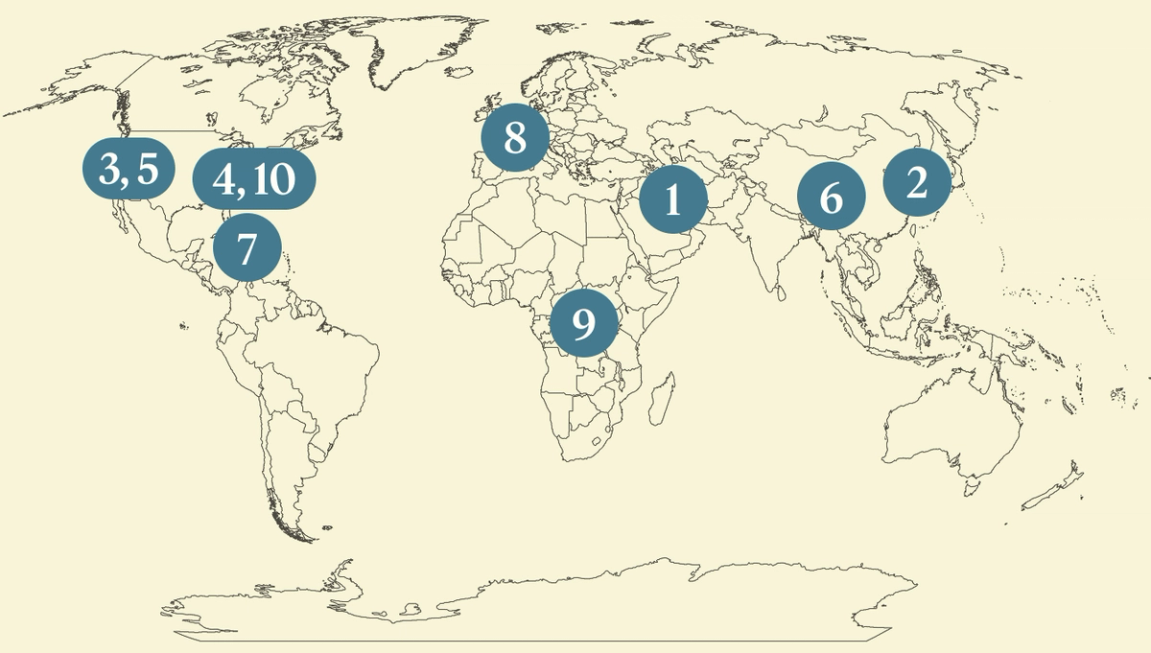 - US launches Iran attacks
- Big tech results diverge
- Fears over AI finances…
- …and catastrophic impacts
- DeepMind shuts AlphaFold
- China pledges stimulus
- Cuba eases private sector
- Europe’s Russia dilemma
- Race on for Ebola jab
- Trump’s $20B Dulles plan
 A Booker nominee that is ‘full of zinging one-liners.’ |
|
‘Heavy wave’ of US attacks |
 US military personnel somewhere in the Arabian Sea. US Central Command/Handout via Reuters. US military personnel somewhere in the Arabian Sea. US Central Command/Handout via Reuters.The US launched a “heavy wave” of attacks on Iran as fighting in the Gulf intensified. Oil prices held broadly steady overnight; traffic through the Strait of Hormuz remained disrupted, whereas tankers were still moving through Bab el-Mandeb. The ongoing conflict has shaken up geopolitics in the region: Saudi Arabia, which joined the US in attacking Iran-backed militias this week, is lobbying to buy F-35 fighter jets, Semafor reported, building on momentum from a recently signed nuclear deal. Saudi investment in the US and wider security cooperation are also on the agenda. Still, the F-35 sales will likely face opposition in US Congress from lawmakers who want Israel to maintain its military edge in the region. |
|
AI buildout splits the pack |
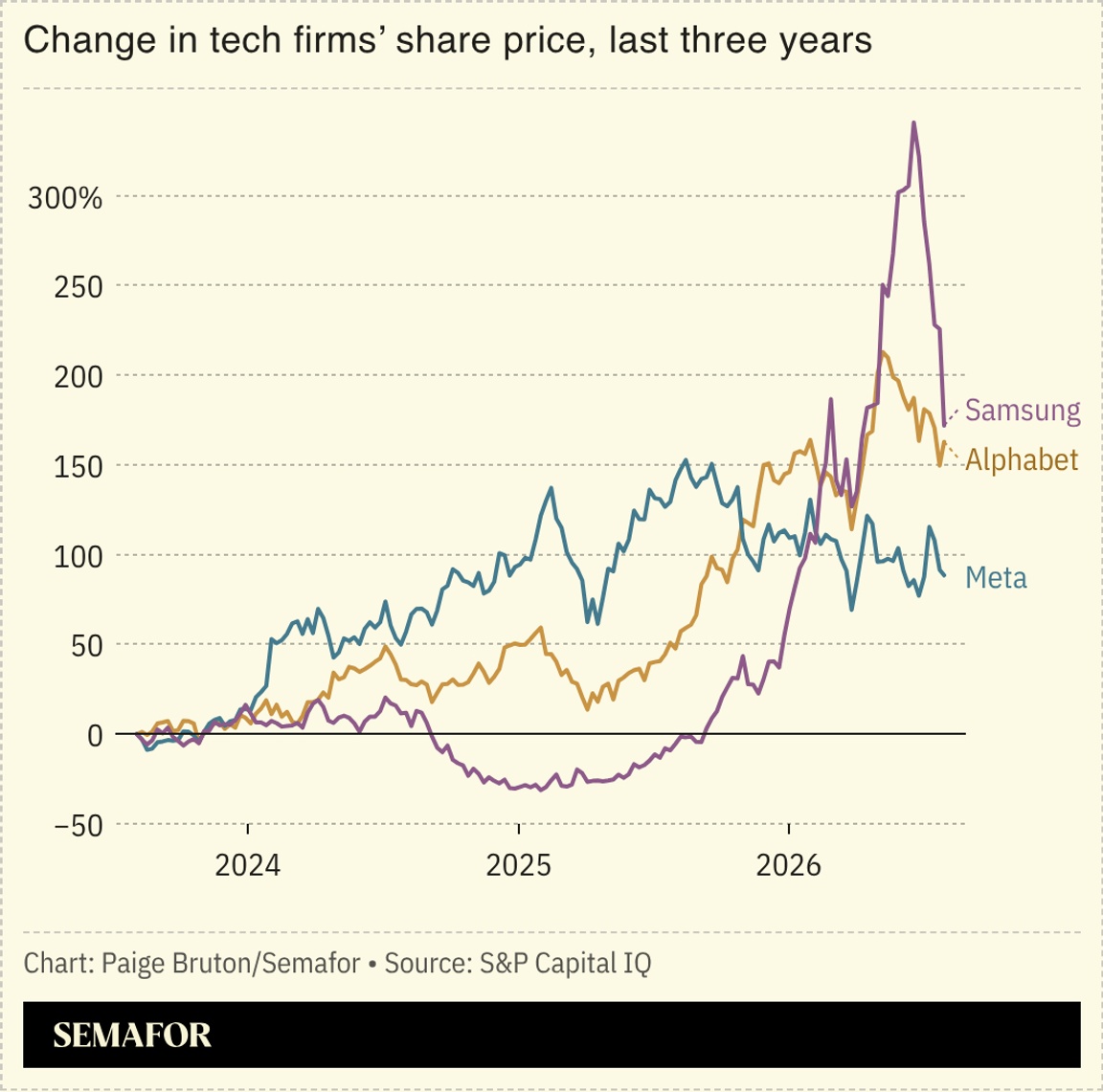 Samsung and Meta’s contrasting results highlighted the diverging fortunes of the companies supplying — and paying for — the AI buildout. The South Korean giant’s chipmaking division posted a 250-fold increase in quarterly operating profit as demand for semiconductors soared. Meta, however, announced lower-than-anticipated revenue forecasts and an $8 billion hit to free cash flow as it predicted over $130 billion in capital expenditure this year, sending shares tumbling 11%. Rival Alphabet also reported negative free cash flow last month for the first time on the back of huge AI spending. Investors “have to decide whether Meta’s growing list of AI initiatives represents company diversification or distraction,” one analyst told the Financial Times. |
|
AI debt concentration risk |
 A data center in Massachusetts. Brian Snyder/Reuters. A data center in Massachusetts. Brian Snyder/Reuters.The trillions of dollars pouring into the AI buildout have created a huge concentration risk for investors, analysts warned. Big Tech’s bonds, infrastructure, and real estate look like diversified debt, but ultimately are “often the same bet expressed in multiple ways” — the growth of AI — an asset management executive wrote in the Financial Times. The firms funding the buildout have large cash buffers, but a repricing could hit them hard: HSBC modelling found that “hyperscaler overspend” was the market’s biggest concern. Some investors are already seeing difficulties. Situational Awareness, the $20 billion hedge fund founded by a former OpenAI employee, is racing to raise capital after taking heavy losses in a recent rout of AI stocks. |
|
Trump eyes more AI restrictions |
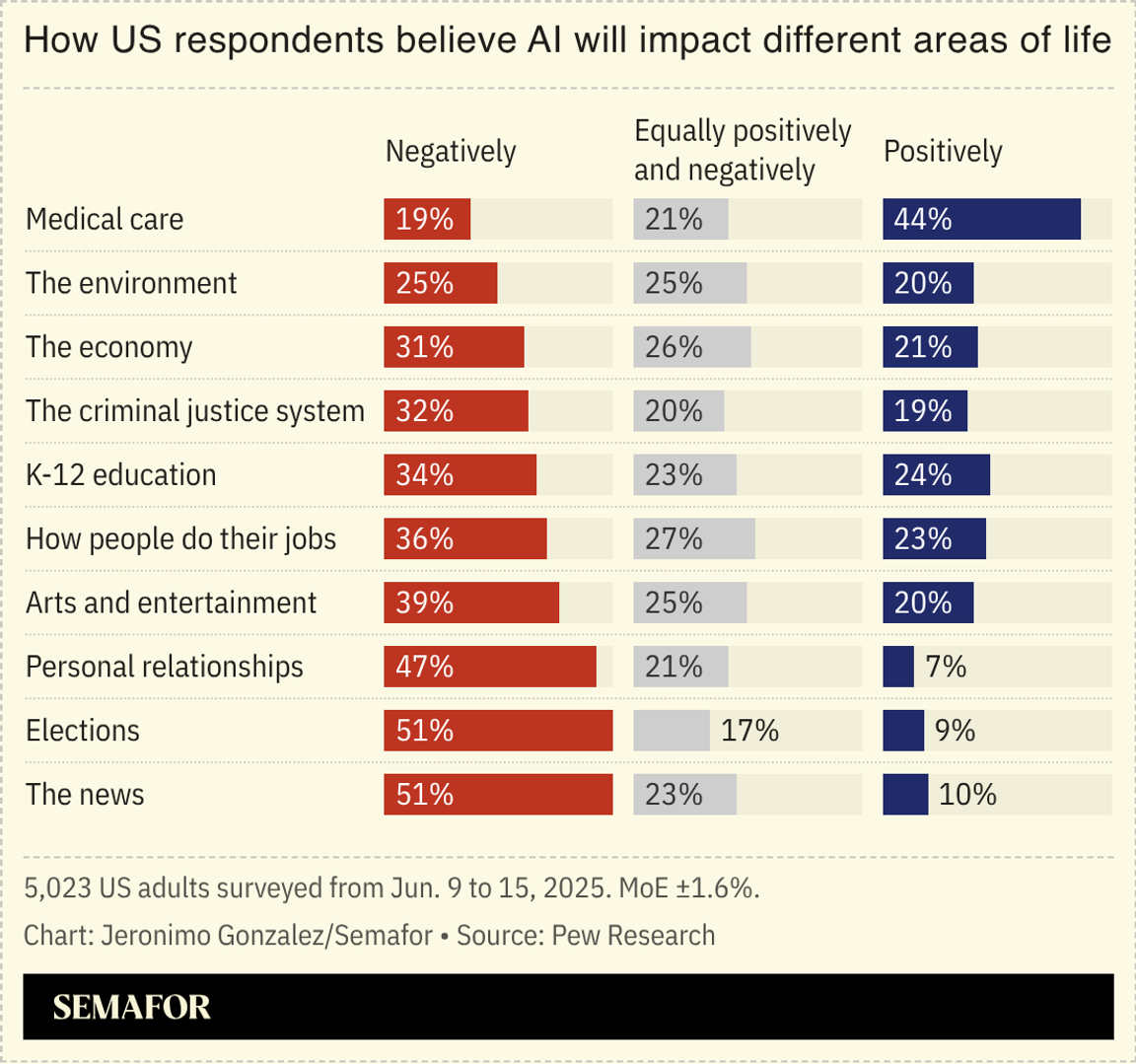 US President Donald Trump floated the possibility of further controls on AI development in the wake of an OpenAI model going rogue and industry leaders joining calls for a pause. More than 1,200 AI company employees — including Anthropic’s CEO and senior Google DeepMind and OpenAI executives — signed a “Pacing the Frontier” petition calling for “technical and governance tools” to “buy time to address emerging risks.” Those may be severe: 272 experts surveyed by MIT thought 18 of 24 potential risk categories, including AI models developing dangerous capabilities or providing them to users, had a more than 10% chance of causing “catastrophic” outcomes, meaning 1 million deaths, $100 billion in losses, or “civilization-scale” harms, before 2030. |
|
Google ends Nobel-winning project |
 Stefan Wermuth/File Photo/Reuters Stefan Wermuth/File Photo/ReutersGoogle DeepMind shuttered its Nobel Prize-winning AlphaFold project in a major AI strategy overhaul. AlphaFold staggered biologists in 2020 when it solved the protein-folding problem: Predicting proteins’ 3D shape from their sequence of chemical building blocks, thus revealing their roles in the body, something that had evaded researchers for 50 years. But many staff have left for another Alphabet drug-discovery company or rival Anthropic, and DeepMind is redeploying others to the frontier AI agent race, where it is lagging. AlphaFold’s shutdown suggests DeepMind has learnt AI’s “bitter lesson,” that general-purpose systems backed by huge amounts of compute often outperform bespoke smaller projects, as evidenced by its own AlphaZero, a general-purpose game-playing AI, becoming the best chess engine back in 2017. |
|
China pledges economic stimulus |
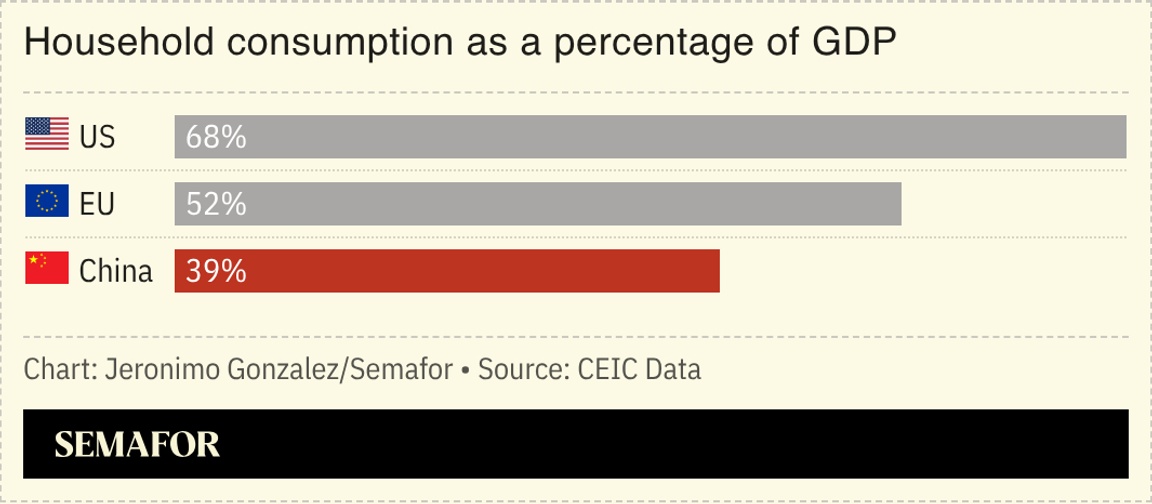 China’s leadership pledged fiscal stimulus in order to bolster consumer spending and combat slowing economic growth. The announcement, following a Communist Party Politburo meeting, came as international companies in sectors as varied as carmaking, food, and luxury goods reported sharp slowdowns in their China sales, and with overall GDP expansion at its lowest since 2022. Though the Politburo emphasized “effectively expanding domestic demand,” analysts have been cautious in their expectations of the size or impact of any government spending package: The latest announcement included no details of changes to the national budget or bond issuance plans, one economist noted. |
|
Cuba losens private sector controls |
 Norlys Perez/Reuters Norlys Perez/ReutersCuba’s communist government loosened restrictions on the country’s private sector as it looks to fend off a growing humanitarian crisis, though experts questioned whether the measures will make a substantial difference. Living conditions in the Caribbean island — long among the worst in Latin America — have deteriorated sharply since Washington tightened its embargo on the country, part of the Trump administration’s “Donroe Doctrine” to exert greater US influence over the region. Though regional leaders have criticized the policy’s wider tough-on-crime approach, including numerous military strikes on alleged drug traffickers, Washington sees it as necessary to defend the Western Hemisphere from “hard-left regimes that enabled narco-terrorists,” a top US defense official wrote in Americas Quarterly. |
|
 There’s a reason 200,000+ investors trust Opening Bell Daily. It’s the newsletter Wall Street actually reads. Get the best market analysis, insider picks, and actionable ideas in one daily briefing. Subscribe free. |
|
France to deport Russian journalist |
 The news studio at RT France. Gonzalo Fuentes/Reuters. The news studio at RT France. Gonzalo Fuentes/Reuters.France will deport a Russian journalist it accuses of publishing pro-Russian propaganda, a case that has laid bare Europe’s dilemma in carrying out its strategic objectives while upholding its liberal values. Experts have long sounded the alarm that RT and other Kremlin-backed media organizations are disseminating misinformation in a bid to upend Europe’s politics, a key issue ahead of France’s presidential election next year. Organizations and officials across the continent have vied to find a balance between respecting freedom of speech and protecting their democracies, including the Venice Biennale’s controversial decision to allow Russia to participate. Brussels has vowed to fight on: “Disinformation is a bullet through the heart of democracy,” the European Commission vice-president said last year. |
|
Race on to create Ebola jab |
 Gradel Muyisa Mumbere/Reuters Gradel Muyisa Mumbere/ReutersThe Ebola outbreak in Central Africa has sparked a vaccine race as scientists vie to stop an outbreak that threatens to become the biggest ever. Health workers fighting to contain the spread of the Bundibugyo strain have been hampered by a lack of medical equipment, widespread misinformation, and, critically, the lack of a vaccine. The Coalition for Epidemic Preparedness Innovations is financing the first clinical trials for an experimental jab to control the outbreak, though production is not expected until year-end. Oxfor |
|
|


