Start or renew a Manning Pro Annual subscription for just $199.99!
SAVE HALF on all books, including MEAP!
All liveVideos and liveProjects $10 each!
Offer ends midnight August 2nd. Only atmanning.com.
It's still summer, and it's the weekend, so we decided to keep our summer sale going until midnight PST Sunday August 2. SAVE HALF on all print and eBooks, get any liveProject or liveVideo for JUST $10, and start or renew a Manning Online Pro annual subscription for $199.99!
New MEAP! Clean Applications with Hexagonal Architecture
Modern architectural styles like “hexagonal,” “clean,” and “onion” all share a straightforward principle: business logic should sit at the center of your software, free of frameworks, databases, user interfaces, and external services. The tricky bit comes when you start putting these ideas into practice refactoring a legacy enterprise mudball, implementing microservices, or building a “modulith” in Spring. Clean Applications with Hexagonal Architecture: Building maintainable microservices and modular monoliths guides you from the hexagonal architecture at the core of modern enterprise software to its practical implementation with examples in Java and Spring Boot.
If you’ve ever stared at a class and asked “where does this code belong?” Clean Applications with Hexagonal Architecture ends the guesswork. Author Enrique Medina Montenegro shows you how to take advantage of an architecture that gives every class exactly one reason to exist and one place to live. You’ll learn to handle input ports, an orchestrating application layer, a domain layer with enforced invariants, and output ports to infrastructure. Finally, you’ll assemble the full structure, then lock it down with ArchUnit rules, and extend this foundation into modular monoliths and microservices. [Read more]
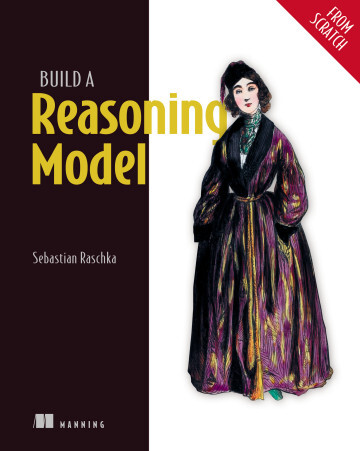
Now in print! Build a Reasoning Model (From Scratch)
A reasoning model is an enhanced LLM that breaks complex problems into intermediate steps, producing more reliable answers on challenging tasks such as mathematics, logic, and code. To achieve this goal, a reasoning model combines model design with pre- and post-training techniques, including inference-time scaling, self-refinement, reinforcement learning, and distillation. As well, they take advantage of benchmark- and judge-based evaluation, answer extraction and normalization, mathematical-equivalence verification, and grading with verifiable outcomes to ensure that responses are accurate, not just whether they “sound right.”
In Build A Reasoning Model (From Scratch), author Sebastian Raschka guides you step-by-step to create your own reasoning model. Starting with a compact, pre-trained Qwen3 LLM, you’ll progressively implement reasoning improvements: chain-of-thought prompting, self-refinement loops, reinforcement learning with verifiable rewards, and distillation into efficient models. You’ll measure performance at each stage and understand exactly how modern reasoning models actually work. No specialist hardware required, as all code runs on accessible cloud GPUs or a standard laptop. [Read more]