
|
Is The Shampoo Effect is actually a book about motherhood?
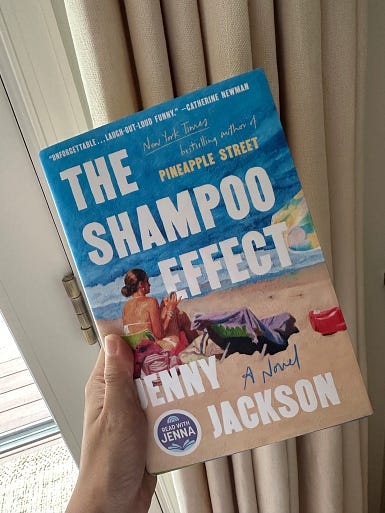
I loved The Shampoo Effect by Jenny Jackson but not for the reasons you think.
|
| |||||||||||||||


Note: This review is mostly spoiler-free except for a tiny part towards the end which I’ve flagged.
On a roll with setting aside my literary tendencies and grabbing “fun beach reads” (thanks Dolly All The Time), I bought one too many books at the store that channeled fun summer energy. I got home and hit decision paralysis, so I polled my Instagram followers on what I should read next. The Shampoo Effect by Jenny Jackson won out by a mile¹.
 |
And…I gobbled it up. The Shampoo Effect was a perfect step-up from a pure romance read. Just literary enough, juicy, and oh-so-gossipy. It wasn’t a page-turner per se (there is no mysterious set-up and the stakes are fairly low), but my thirst for scandal knows no bounds (whose does?) and this delivered in literary form.
The book is structured in third-person POV chapters, each one dedicated to a character's secrets and anxieties—aka the perfect structure for gossip and understanding how a character sees another. There were broad strokes of a theme and plot (including one “big reveal” moment), but The Shampoo Effect was mostly a character-driven romp, which is exactly the type of novel I’m loving lately (see: Lost Lambs by Madeleine Cash).
The premise: Caroline Lash² is a young twenty-something woman living in NYC who hates her publishing job—one that she landed thanks to her mother, a big-name, self-absorbed parent. Feeling dissatisfied with her nepo baby life, Caroline leaves the city to ensconce herself in a quiet seaside town in Massachusetts called Greenhead for a writer’s residency.
There, Caroline meets and falls in love with local Van Whittaker, a granola bar of a man whose main traits are being a Good Guy, picking up trash along hiking trails, and working as an environmental scientist. Through Van, she meets his group of local lifelong friends, all in their mid-thirties, who are in various states of domestic dissatisfaction.
 |
Augusta, for instance, is an old-money type, whose pink house on the hill has stables for horses and whose three kids are her world. But she senses something is up with her husband, Colin, when she finds lacy underwear in between the couch cushions. Fran, meanwhile, has been surrounded by male energy all her life, cleaning up after their messes: she’s got all boys herself, and her husband RJ is a boy-man who drinks too much beer and whose one joy in life is the annual town tradition of climbing a greasy pole. Even Fran’s job in engineering means her work trips involve being surrounded entirely by dudes who just want to talk about Star Wars. Lastly, there’s Bailey, Van’s attractive, blonde high-school ex…whom he has knocked up (oops). (Bailey is a “body” whereas Caroline is a “brain,” Caroline thinks.)
Things get sticky when Bailey decides to keep the baby but definitely doesn’t want to stay with Van—or does she? Caroline’s presence is messing everything up in this friend group. Their social equilibrium is thrown off kilter by this mysterious newcomer. Her alien presence must be eradicated. Meanwhile, Caroline finds their group dynamic weird and incestuous. When things get to be too much, she decides to do something that blows everything up further.
And thus is the juicy set-up for this novel.
And don’t get me wrong, the book is juicy. But among the dramatic reveals and betrayals, what I personally found most enjoyable about the novel was not the drama but the accurate depictions of the stages of motherhood within it. These scenes from the book were the most vivid and successful for me, and led to a more enjoyable reading experience. I’ve found that when a book doesn’t do this well and gestures vaguely at “early motherhood,” I get annoyed and have to walk away. Sell me on at least one believable scene on what it’s really like to negotiate with a three-year-old!
But The Shampoo Effect nails it. Rather than leaning too saccharine or too vulgar, the book captured the messy mix of modern parenthood so well. Of course, there is the all-consuming love and tenderness (Augusta looking on at her baby, “a tiny glowworm” asleep in her sleep sack, “bum sticking up in the air.”), but there’s also the mind-numbing boredom; the unending emotional, mental, and physical labor; the domestic wrinkles it can cause; and even revulsion.
There is this bit about breastmilk, for instance. When Augusta combines a few stored bottles into one, only to find they've separated into “various states of thickness,” she gives them a little shake, and gags at “the white solids sliding down the side of the plastic bottle like yogurt.” She finds one bottle of breastmilk that’s green, and shoves it “to the back of the fridge behind the lettuce” so her 18-year-old babysitter won’t see it. I laughed! I know breastmilk is the sacred sustenance by which my babies grow and have grown, but damn, I am myself revolted by the stuff sometimes, even as it comes out of my own body!!
And here is a chore that most moms I know are too familiar with: the dreaded clean-out of stuff and overgrown clothes in the kids’ dressers. Wired and “miles from sleep” at two in the morning, Augusta works through the kitchen, then the kids' cup drawer—matching lids to bottoms, tossing anything with a broken straw. She cleans the front hall closet (“a place of perpetual irritation for her”,) sorting shoes into piles to donate or save, “half of them disgusting with use, half of them nearly pristine but rejected by her children for reasons sundry and various” including “one loathsome pair that shed glitter upon every wearing.” Who among us hasn’t encountered said loathsome pair?
Also, there were just parts that were really, really, funny:
“Mommy, Jane kicked me in the VAGINA!”
“That’s not true!” A redheaded girl came running through the doors from the greenhouse clutching a honey straw. “Charlie kicked ME in the vagina! And I kicked him back in the PENIS!”
“…Can you please not scream about your privates?” Augusta scolded them. “Just say that you kicked each other in the groin. Or better yet, just that you kicked each other.”
Most of the parents in this book clearly love their children but also grapple with the various brain-melting mini-dramas of parenting. These moments kept me turning the pages as I saw myself reflected in each parent in different ways.
I say most of the parents because The Shampoo Effect offers a look at the other end of the parenting spectrum, too. The one where instead of sacrificing yourself to it completely to the point where you subsume all your own needs (Augusta, Fran), you’re