
|
The Enshittification of Everything (Part 3)
Power in the Age of Oligarchy. Third part of a 3-part series.
| |||||||||||||||


 |
Friends,
It is important to understand that Trump is not the cause of the enshittification of America. He is a consequence. Unless the system is fundamentally changed, the enshittification will continue even after Trump is long gone.
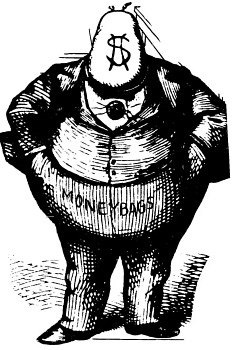
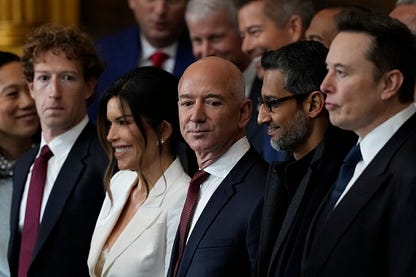
As I’ve shown, wealth and power in America now reside in a relatively small group of (almost entirely) men — the American oligarchy. My prime example has been Jamie Dimon, chair and CEO of JPMorganChase, the largest bank in the world — because he’s regarded by corporate Democrats as the most trusted business leader in America — but I could equally focus on Peter Thiel, Jeff Bezos, Mark Zuckerberg, Elon Musk, Larry and David Ellison, or any other billionaire using his vast wealth to create and enhance his political power.
The Core Contradiction
The oligarchy is not interested in serving America, yet it dominates American politics and essentially runs the American system.
The oligarchy is not committed to the common good. It does not seek to raise the wages of working Americans, reduce inequalities of wealth and opportunity, guarantee all Americans access to good healthcare and a world-class education, or stop climate change.
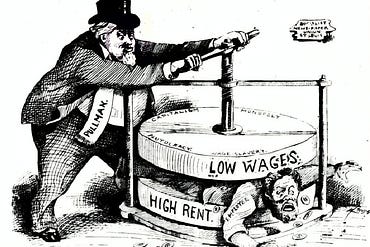
The oligarchy’s allegiance is to itself, and its major interest is enlarging its wealth and power. The easiest way for the oligarchy to accomplish this is to hold down the wages of working people, roll back regulations, enlarge its monopolies, find ever-cheaper places around the world to produce products and services, fight unions, and secure giant tax cuts for it and its corporations that result in less money for education, healthcare, and everything else most Americans need.
The oligarchy cannot fulfill both roles: It cannot advocate for its giant banks or monopolistic corporations and simultaneously lead the nation. Dimon may sincerely believe that he’s a patriot before he’s the CEO of JPMorgan, but we would be foolhardy to rely on it.
The difficulty is not that corporate power is beyond the control of the American government. It is that corporate power controls the American government. Yet giant American corporations have no special allegiance to the United States and no responsibility for the well-being of Americans.
This contradiction has spawned three big conventional ideas about the American system that are dangerously wrong.
 |
Conventional but deceptive idea #1: Americans are richer than the citizens of other rich nations
A few Americans are, but the vast majority are not, when you consider all the public benefits that the citizens of other nations receive. Note, for example, that:
— Most citizens of other wealthy nations receive free or nearly free healthcare, and most get free or nearly free college tuition. Americans receive neither.
— Among the three dozen wealthy countries in the Organization for Economic Cooperation and Development, the United States has the lowest minimum wage when measured as a percentage of the median wage. The typical American worker puts in more hours on the job than Canadian, European, or Japanese workers.
— The United States is the only wealthy nation that does not guarantee paid family leave. In Europe, the norm is three months paid leave. At most, Americans get 12 weeks of unpaid leave.
— America is also the only rich nation that does not guarantee paid sick days. It is the only one that does not guarantee workers any vacation at all. The European Union’s 28 nations guarantee at least four weeks of paid vacation.
— In other rich nations, most people who lose their jobs receive more generous unemployment benefits than do Americans. Employers cannot fire workers at will, as they can here.
— American corporations distribute a smaller share of their earnings to their workers than do European or Canadian-based corporations.
— Top corporate executives in America make far more money than their counterparts in other wealthy countries, and inequality of income and wealth is far wider in the United States than it is in any other wealthy country.
— The American middle class is no longer the world’s richest. Considering taxes and transfer payments, middle-class workers in Canada and much of Western Europe are better off than in the U.S. The working poor in Western Europe earn more than do the working poor in America.
Why are most Americans poorer than the citizens of most other rich nations? It is because of the way power is allocated and wielded in the United States, by contrast with other rich countries. Consider:
— Labor unions are stronger in Europe and Canada than they are in America, able to exert pressure both at the company level and nationally. Only 6 percent of American private-sector workers are unionized. As former New York Times labor correspondent Steven Greenhouse has observed, “In no other industrial nation do employers fight so hard to defeat, indeed quash, labor unions.” Over 25 percent of Canadian workers belong to a union, as do 37 percent of Italian workers, 67 percent of workers in Sweden, and 25 percent in the U.K.
— Most other rich nations are parliamentary systems in which workers are represented by parties that specifically advocate for them. The United States has a two-party system in which the winning party gets all of a state’s electoral votes, thereby discouraging third parties.
— Elections in other rich nations are less affected by big money than are elections in the United States, because other nations have stricter restraints on money in politics.
— Governments in these nations often devise laws through tripartite bargains involving big corporations and organized labor, which further binds their corporations to their nations’ workforces.
For all these reasons, Americans don’t get nearly as good a deal as do the citizens of other rich nations. Governments elsewhere impose higher taxes on the wealthy and redistribute more of it to middle- and lower-income households.
 |
Conventional but deceptive idea #2: The “free market” is separate from government
The second conventional idea perpetrated by the American oligarchy is that we work and live in a “free market” that’s neutral and natural — existing outside government, unaffected by how power is wielded in the system.
We are repeatedly told that whatever inequalities and insecurities the market generates and whatever negative consequences it causes are beyond our control. Efforts to reduce inequality or insecurity are described as constraints on the market’s freedom, likely to cause grave unintended consequences.
By this view, if some people aren’t paid enough to live on, the “free market” has determined they aren’t worth enough. If others rake in billions, they must be worth it. If millions of Americans are unemployed or their paychecks are shrinking or they work two or three part-time jobs with no idea what they’ll earn next month or next week, that’s just the natural outcome of market forces.
If the planet’s survival is endangered because of fossil fuels, that’s at most an “imperfection” in the market. If government attempts to deal with such market imperfections, it must do so modestly and carefully because the “free market” knows best. As Jamie Dimon put it, “Don’t mess up the machine that creates the value so you can do these things. The economy is what gave us everything.”
This is bunk. In reality, the “free market” is nothing but a set of laws and rules about: What can be owned and traded (corporations? slaves? machine guns? nuclear bombs? babies? votes?