




The End of Oak Street is a movie from another time. I mean this both literally and figuratively.
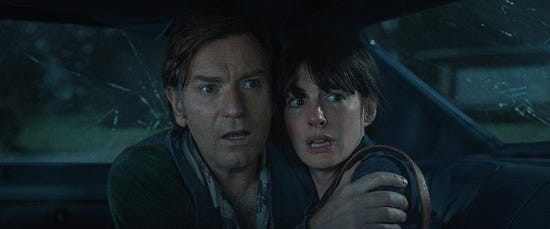
In the literal sense, The End of Oak Street is about a street that is transported back in time. We open on an unhappy family at a block party sometime in the early 1980s, judging by the clothing, cars, and music. Denise Platt (Anne Hathaway) is struggling to keep it together as her marriage to Greg (Ewan McGregor) disintegrates. She’s unhappy and writing a novel about that unhappiness; he’s out of work and delivering pizzas to make ends meet.
Their kids, Audrey (Maisy Stella) and Brian (Christian Convery) are like the kids of so many 1980s movies: not nearly as oblivious as their parents seem, but hopeful life can revert to normal. Though everyone’s confusion may be amplified by how disjointed this whole opening segment is; there’s a weird disconnect here between how Denise and Greg react to his leaving the block party to make deliveries and what we learn later about his work situation. But picking nits about how much Greg has told Denise about their financial difficulties seems moot when, moments later, there’s a storm, a flash of light, and the entire neighborhood goes back to the Mesozoic for reasons that are never really explained.
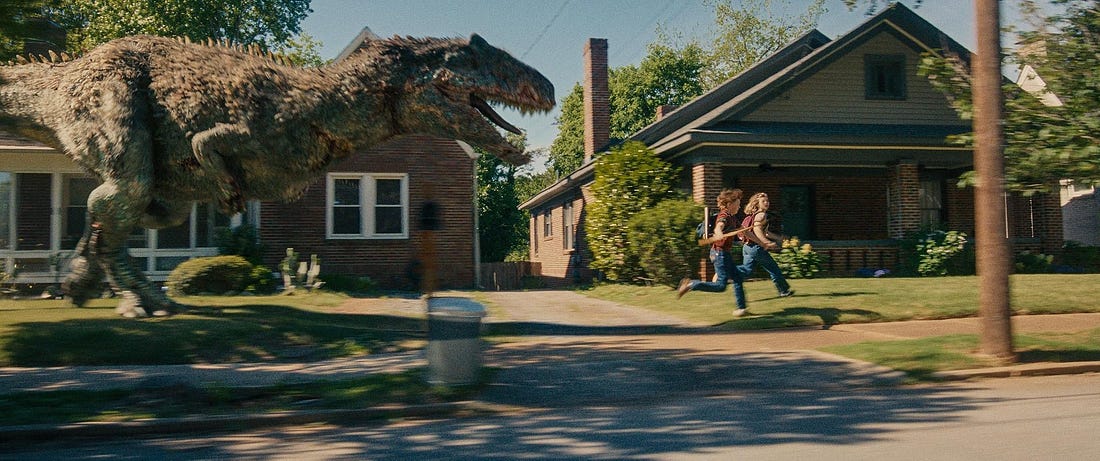
Again, this is quite literally a movie about a town transported through time. The people of this pleasant neighborhood wake up as bait for dinos, mangled by marauding meatasauruses. (And I feel the need to warn that this is a hard PG-13; my kids love the first two Jurassic Park films, but I don’t know that I’d take them to this. Not just because of the violence—again, people literally eaten alive/ripped apart—but because there is an extended sequence of dog peril.¹) The last hour or so of The End of Oak Street is like all the best parts of the Jurassic Park films rolled into one: an extended chase-hide-escape-repeat segment, featuring raptors, T. rexes, pterodactyls, and, uh, giant snake things, with writer-director David Robert Mitchell doing an outstanding job of building the suspense by hiding the beasties just long enough to stoke our interest and let the terror mount.
Just to linger on Mitchell for a moment, this movie calls to mind the work he did in It Follows, a film in which a stranger slowly walking towards you became a portent of existential dread. The heroes of that movie aren’t being chased by dinosaurs but by a poltergeist that functions a bit like a sexually transmitted disease, ambling at a steady pace in the direction of those who have been cursed. Never before has an audience been kept on the edge of their seat by the image of an old woman walking across a high school campus; Mitchell knows precisely where to position his actors to instantly convey a sense of space and the directions from which danger might spring. (For a bit more on It Follows, check out Assigned Viewing, below.)
 |
For all its references to 1990s dinosaur movies and 2010s indie horror, however, The End of Oak Street is rooted firmly in the cinema of the 1980s. And that’s what I mean, figuratively, when I say this is a movie from another time. It is an original film, bereft of intellectual property, focused on a family in peril that comes together through adversity, with a high-concept idea that is, on its face, a little goofy. I mean, look: It’s a goofy idea, this whole ‘unexplained wormholes transport a town back in time 200 million years, forcing ordinary folks to face off against dinosaurs.’ But if you can abide that weirdness, you realize that this is a more Spielbergian film than anything Steven Spielberg himself has made in the last few decades. (No surprise that J.J. Abrams and Bad Robot, the team behind Super 8, produced The End of Oak Street.) This movie is pure Amblin, undiluted 1980s.
The domestic box office has been on a real winning streak lately, particularly in the form of mega-blockbusters like Spider-Man: Brand New Day and The Odyssey. But the real story of the year has been the surprise success of originals like Obsession and nouveau-IP like Backrooms. But those were low-budget breakouts; The End of Oak Street is a much pricier affair, with genuine stars and big effects. And, again, kind of a weird premise, one that’s hard to explain in a trailer. It’s a strange movie.
But it’s an original, and I think you’ll enjoy it.² And we need strange, one-off originals like this to succeed if we want movies beyond the big tentpoles driven by superheroes and tired franchises.
Support our growing coverage of movies, books, arts, ideas, and culture—become a Bulwark+ member today:
Carr trouble
On this week’s Bulwark Goes to Hollywood, I talked to FIRE general counsel (and former chief counsel to FCC for a time in the 1990s) Robert Corn-Revere about the unprecedented overreach of Brendan Carr’s FCC and his active efforts to stifle speech that hurts the president’s feelings. Of particular interest here is Carr’s effort to redefine “in the public interest” as “in Trump’s interest,” a dangerous precedent for a regulatory body.
