
|
Aug 15, 2026
|
|
|
|
| Welcome, Weekenders! In this newsletter: |
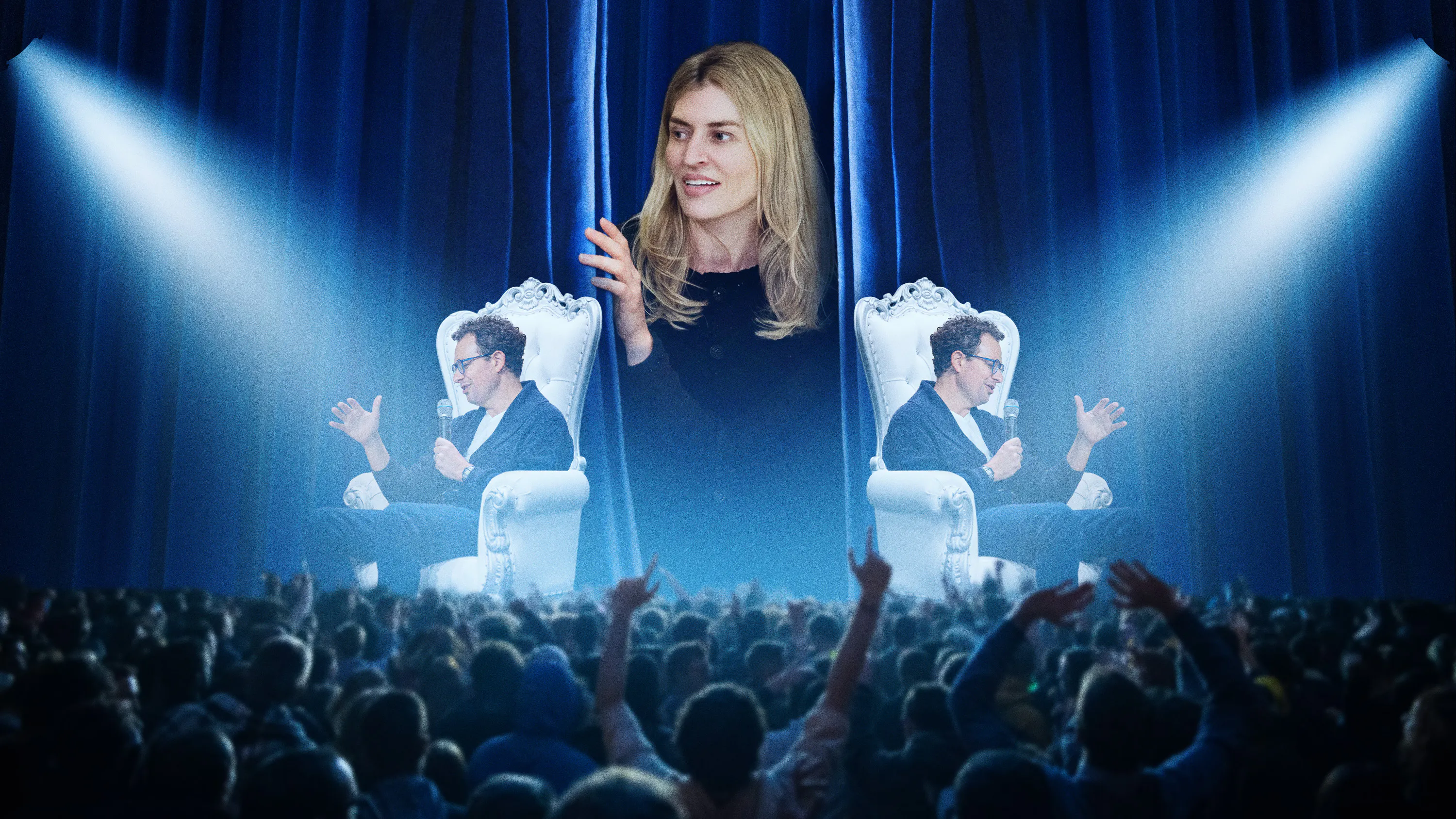
| • The Big Read: Inside the ascendance of Anthropic’s “first lady” |

| • Elon Musk’s flying roadster is finally ready |
| • Plus, Recommendations—our weekly pop culture picks: “The Betrayal of Shohei Ohtani,” “Little Blue Dot” and “Furious” |
| |
| What’s the best measure of AI’s great proliferation? |
| Most obviously, we can sum up the enormous amounts of money generated by OpenAI and Anthropic—a task my colleagues at The Information approach with great vigor. We could also look at how the technology has become a top-of-mind issue in Washington. Or we might consider how AI has become a frequent villain of choice in Hollywood—particularly in horror films. With the technology getting so much screen time, good old Michael Myers must be close to firing his agent. |
| Another indication may be the fact that AI is at the center of a very fine new off-Broadway play, “Disruption,” headlined by film star John David Washington (“Tenet” and “BlacKkKlansman”): Live theater is marvelous, but it takes something powerfully momentous to push it away from its comfort zone of fairy tales and rhapsodic animals. “Disruption” follows “Data,” another off-Broadway production about an algorithm gone amok, from earlier this year and “Maybe Happy Ending,” a Tony-winning musical about a pair of robots who fall in love, from 2024. |
| No one gets a fully joyful conclusion in “Disruption.” The titular breakthrough comes at the hands of Washington’s tech gazillionaire character, Nick. (And yes, John David really does both sound and look a lot like his father, Denzel.) With a blockbuster IPO behind him, he has hastened onto his next venture—an AI startup—and already has Eric Schmidt on the hook for a $50 million investment. But he wants more and knows what he needs most is tangible proof of his predictive algorithm’s effectiveness in guiding people’s lives—ostensibly toward truest contentment. So Nick allows the AI to begin studying six of his oldest friends unbeknownst to them, of course. Heartbreak and tragedy ensue. |
| “Disruption,” which runs through the beginning of October, originated in a London production in 2023, receiving a raft of warm reviews. Playwright Andrew Stein deserves credit for a fair amount of prescience: He penned an initial draft back in 2018. |
| “ChatGPT came out for public use between when our production in London was announced and when rehearsal began,” he recalled. “So we hit this moment where this went from being a sci-fi thing to being a zeitgeist thing.” |
| In preparing “Disruption” for its London debut, Stein and director Hersh Ellis pored over books written by Ray Kurzweil and Yuval Noah Harari. “I would describe Andrew and myself as ‘AI curious,’” said Ellis. “We’re both people who believe in the power and the potential of what AI can do. And we’re also people who are not naive to what could happen if it goes unchecked.” |
| Exporting the play to New York, they kept the script mostly unchanged. A larger budget has allowed a significant upgrade to the production values, with seating that looks down at the stage: The fishbowl-like setup provides an intimate observation of the characters, a parallel to the omniscient AI’s own minute inspection of them. |
| These days Stein relies on AI as a constant resource for research—he and Ellis are at work on a new play about the building of the Panama Canal—but finds it steadily creeping into more of his everyday life. “Sometimes it will say to me something like, ‘Based on what I know about you and your patterns,’ and that’s when I know that, yeah, I’m in deep,” he said.—Abram Brown (abe@theinformation.com) |
| |
|
| The Big Read |
 |
|
| Before Cami Clark became a quiet key counselor to her husband, Anthropic CEO Dario Amodei, she founded her own startups and crossed paths with Jeffrey Epstein. |
 |
|
| Tesla has explored a variety of designs for its much delayed next-generation Roadster, including a repurposed Model S Plaid and looks that borrow from the Lamborghini Countach and Lockheed SR-71 Blackbird aircraft. |
| |
 |
| Listening: “The Betrayal of Shohei Ohtani” |
| In 2024, history repeated itself: A betting scandal erupted in baseball involving arguably the sport’s most prominent name, Shohei Ohtani, the Los Angeles Dodgers’ pitcher-slugger extraordinaire. It resurfaced memories of Pete Rose, the all-time hits leader banned from baseball for gambling on the sport, and the 1919 Chicago Black Sox, who’d been in cahoots with a gambling ring to throw the World Series. What had happened with Ohtani turned out to be a complex affair: Money had indeed flowed from his bank account to a bookie, but that had taken place without his knowledge. His interpreter and aide-de-camp, Ippei Mizuhara, had siphoned off millions of dollars from Ohtani and had been the one placing the bets. |
| ESPN owned much of the initial coverage of the Ohtani saga, and reporter Tisha Thompson returns to it in “The Betrayal of Shohei Ohtani,” the latest podcast from the network’s 30 for 30 documentary division. A slick retelling of the drama, it broadens the tale with journalistic verve: Thompson explains how she and her colleagues followed the money going to the gambling operation and pursued every twist and turn: At one point, Mizuhara told Thompson he had fessed up to Ohtani—within hours, it became clear that Ohtani was still entirely in the dark. Investigators spoke to Thompson, too. (Cumbersomely, they needed to rely on Google Translate to parse communication between Mizuhara and Ohtani—imagine what Gemini could’ve done for them.) The series also provides an intimate look at the psychology behind addictive gambling, and it left me reflecting on how much more trouble someone like Mizuhara can get themselves into these days, a time when Kalshi’s revenue can double by billions of dollars in the span of a few months.—Abram Brown |
| Reading: “Little Blue Dot” by Katherine Dunn |
| Earlier this month, I drove from Munich, Germany, several hours into the Austrian alps. There I spent several days hiking, then returned to Munich and trained to Berlin, where I rented a bike and zipped merrily through a city that sprawls across 344 square miles—making it seven times larger than San Francisco and 15 times bigger than Manhattan. I suffered nary a single wrong turn, and I never picked up a physical map. |
| As I went, a thought echoed in my mind that was promptly reinforced by “Little Blue Dot,” an engaging history of the development and world-altering effects of the GPS system: Traversing strasse and alp would’ve been much more arduous without the little dot on my phone guiding me via Google Maps and AllTrails, a hiking app. As author Katherine Dunn notes: “The physical markers that guided us pre-GPS, even our sensory skills of understanding time and place, have become rusty at best.” |
| “Little Blue Dot” argues that much of the world’s recent past maps pretty well to the rise of that satellite network—particularly in the collision of geopolitical forces and rivalries. GPS was born out of Cold War anxiety and an American desire to develop the most sophisticated weapons it could: A bomb is only as effective as your knowledge of where to drop it. During the ’90s, the technology began to find use on the home front, too, and, of course, it underpins a great number of the companies that arose during the mobile-era boom: An Uber does not reach you without it, and neither does that box of dog biscuits. As GPS has reshaped our lives, it has ushered in a time marked by a distinct discordance. The network has, for instance, made it easier to track climate change. It has also made it more possible than ever to travel the planet, exacerbating climate change. “GPS made it easier than ever to kill people, but also to rescue them,” writes Dunn, a former Wall Street Journal reporter and Fortune magazine editor. “To better understand our world and yet continue to destroy it.”—A.B. |
| Watching: “Furious” |
| At a time when Hollywood still seems overly devoted to rummaging through old VHS tapes for content to repurpose onto our screens, I worry the suits there will get the wrong idea from Hulu’s “Furious,” loosely based on a 1987 film, “Black Widow,” about a female federal investigator pursuing a female killer: that they really should keep right on trying to reboot anything and everything. I’d encourage them to do so only if they can shatter the known limits of biology and somehow clone “Furious” writer-creator Elizabeth Meriwether, giving all the projects to her duplicates. In less capable hands, “Furious” would be an unfun, trope-laden mess. |
| “Furious” has some familiar cop show beats. There is a young, damaged FBI rookie, Alice, who seeks out the mentorship of a worn-down older agent, Nora, in a quest to catch a quick-witted killer, Cathy, whose vengeful streak elicits some sympathy. Fortunately, Meriwether has a trio of very fine actresses giving life to those very standard character types: Emmy Rossum (“Shameless”), Quincy Tyler Bernstine (a stage actress with a Tony Award nomination for “Doubt: A Parable”) and Lola Petticrew (“Say Nothing”), respectively. The cat-and-mouse game between Alice and Cathy is propulsive and captivating, with Cathy offing a slew of Jeffrey Epstein types whom she previously met as a captive in a child sex-trafficking ring. Alice herself is wrestling with her own past of domestic abuse. Nora stinks of regret and tequila. It might be a tediously grim affair, but it is not, and the show is well paced, with moments of real humor, a testament to Meriwether’s comedic background: Before “Furious,” she did “New Girl,” the Zooey Deschanel sex-capade. (You may have also seen her 2022 effort: “The Dropout,” Hulu’s Elizabeth Holmes biopic series.) As far as the funnies go, some kudos should be bestowed directly on Tyler Bernstine: She gives tremendous weathered, withering side-eye.—A.B. |
|
|
|




 Gift Subscription