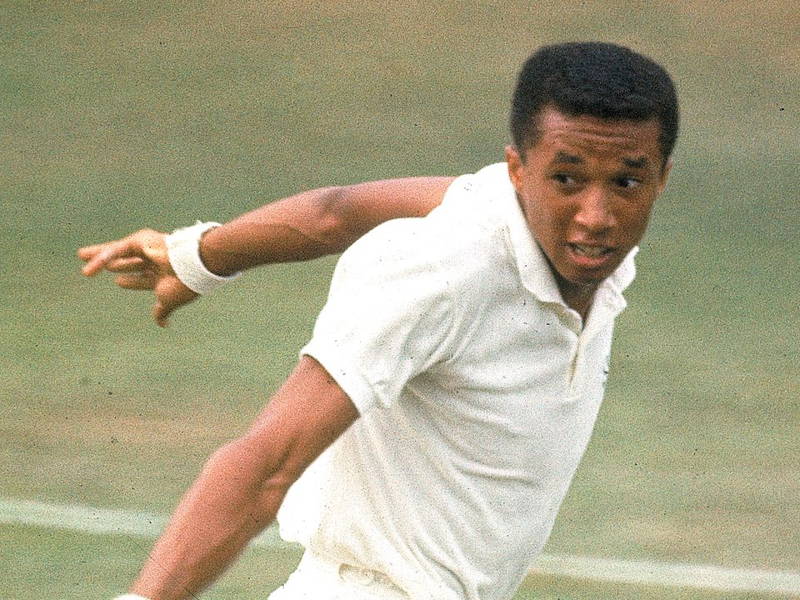
In 1968, John McPhee was looking for a subject—or, rather, two subjects. After a decade of writing Profiles of individuals, he decided he wanted to try a double Profile. “In the resonance between the two sides, added dimension might develop,” he later wrote. “Maybe I would twice meet myself coming the other way. Or four times. Who could tell what might happen? In any case, one plus one should add up to more than two.” But he struggled to settle on his subjects—until he happened to be watching the 1968 U.S. Open semifinals between Arthur Ashe and Clark Graebner. The search was over. The result—a point-by-point account of the match that cuts in and out of its subjects’ perspectives, and their lives—is one of the most remarkable pieces of sportswriting ever published.
Ashe grew up as a Black man in segregated Richmond, Virginia. When his coach, Walter Johnson, first met him, Ashe was so frail that Johnson wondered if he’d suffered from rickets. Graeber was a country-club kid from suburban Milwaukee. His All-American good looks reminded people of another Clark, Clark Kent, and his nickname in tennis was Superboy—except among those who referred to him as Herr Graebner, on account of his straight-backed posture and Teutonic bearing. Just months before the match, Martin Luther King, Jr., had been murdered. McPhee didn’t mention the event, and he didn’t have to. He let the resonance do its work.
The resonance is particularly powerful now. At the U.S. Open on Friday, Frances Tiafoe and Ben Shelton became the first two Black American men to contest a Grand Slam semifinal, and the winner, Shelton, became the first Black American man to reach a U.S. Open final since Ashe did it a second time in 1972. Today, Shelton will try to become only the third Black man to win a Grand Slam title since Ashe and Yannick Noah, who won the French Open in 1983. Not enough has changed, clearly, since Ashe beat Graeber in the semifinals that day. But at least one thing has. What stands out in McPhee’s portrait of Ashe is his solitariness. It’s clear from the piece that Ashe didn’t have a choice. But Tiafoe and Shelton, who are both part of a tight cohort of American players, finally do. |