
|
 |
| ||

Global coordination on AI is hard work, but not impossible.
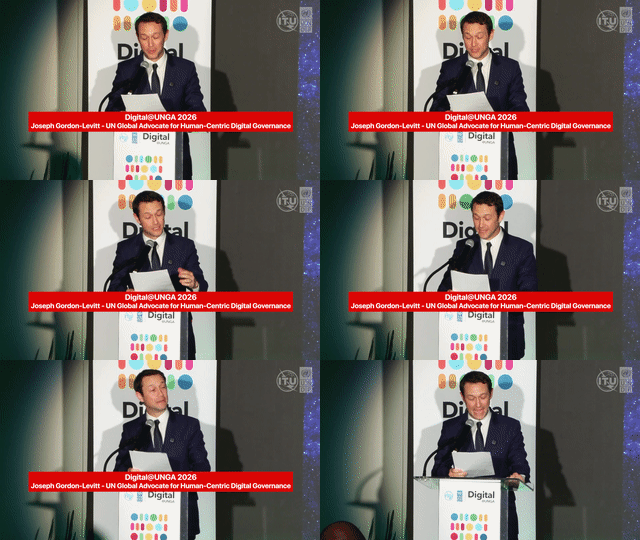
My address at Digital@UNGA 2026 during the United Nations General Assembly.
|
| |||||||||||||||


Speech from Digital@UNGA 2026
So the question of the night is: Who gets a say in our digital future? Well, I think we can all agree that the answer should be everyone. But the question behind the question is…how?
Maybe people will get their say by choosing where to spend their money. The good old free market. But we know what happens when we let private companies build the digital world for profit, and not for the public good. We’ve seen the extreme concentration of money and power into the hands of a few big tech companies while the global community was divided and conquered—or maybe better said, was conquered and then divided.
But really we can’t just blame Big Tech. We all have to take some responsibility too. These past couple decades, we didn’t do enough to lay down the law and properly govern the Internet and social media. And now the big question is — are we going to make the same mistake with AI?
So, here in the United States, a big majority of us want our government to step in and regulate this technology. It’s actually a rare instance in our country right now where people from across the political spectrum, Left, Right and Center. They all agree with each other.
And those who disagree, who are against AI regulation, I’ll tell you what they mostly say. They say even if one country does it, other countries might not. They talk about it like it’s an arms race. They say that global coordination is impossible, so we might as well not even try.
Well, here we are at the United Nations. From where I’m standing, global coordination looks like a lot of hard work, but it does not look impossible.
Yesterday, I was telling my kids where I was going, and I was trying to explain to them what the United Nations is. And I said to them, “Do you remember when we went to Hir-OH-shima?” And my 9-year-old goes, “Daddy, it’s Hiroshima,” which was pretty great. But no, my wife and I did take our kids to Hiroshima recently, and not just because we wanted them to see the tragedy there, but because we wanted them to see human resilience.
And I was saying to them yesterday, “Do you know what happened after the horror of an atomic bomb landing on a city full of people?” What happened was, people from all over the world got together, in a newly created space called The United Nations. Where folks from every corner of this planet could collaborate on solving big global problems. And the UN General Assembly’s first ever resolution — Resolution 1, passed in 1946 — was about nuclear weapons. And it’s a long story, but to this day, there hasn’t been another nuclear bomb dropped on people.
Now of course, nuclear weapons and AI are very different, but they both demand global coordination. We’ve done it before. It happened right here. And now it’s time to do it again. I am not about to tell my kids that we grown-ups just stood by while a few profit-driven companies designed their future for them.
Everyone truly should get a say in what the digital future will be. And I want to thank each and every one of you here tonight for the work you’re doing to make that a reality. Thanks.
| ||||||||||


