| Keith Stuart |
 |
|
| |
There’s an important semi-nostalgic movement happening in games, and I’m excited about where it’s heading. But I don’t want to get ahead of myself here.
Over the last five years, major publishers, obsessed with the success of “forever games” such as Fortnite, Minecraft and Roblox, have been throwing hundreds of millions of dollars into their own sprawling, endlessly updating, battle-pass-infested mega franchises – each designed to take all our time and money. The result has been astounding failures such as Concord, Mindseye and Tales of the Shire. Even the good games – Crimson Desert, Path of Exile 2, Blood of the Dawnwalker – are so bloated they have become the unyielding masters of our precious few hours of free time.
It’s a relief, then, to see a growing number of mainstream titles heavily inspired by arcade design conventions, and intended as discreet, contained experiences. Along with the excellent driving game Star Wars Galactic Racer, which I rave about below, there’s Ace Combat 8: Wings of Theve, an unreconstructed air-combat shooter that doesn’t want to become your whole life. You don’t have to romance your F/A-18F Super Hornet (although that does sound sort of cool), you don’t have to build your own airbase. You fly, you shoot things, there’s a story in the background, the end. It’s been equally lovely to see the success of Marvel Tōkon: Fighting Souls, a demanding 2D fighting game with complex interlocking power-up systems – the sort of thing my friends and I might have played in the arcades in 1993 before buying it on imported £100 Neo Geo carts.
|
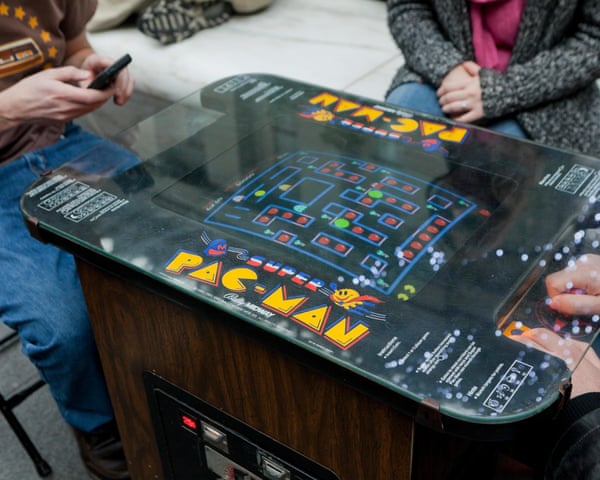 |
 A quick round … in an age of endless online games, the appeal of the arcade is enduring. Photograph: B Christopher/Alamy A quick round … in an age of endless online games, the appeal of the arcade is enduring. Photograph: B Christopher/Alamy |
|
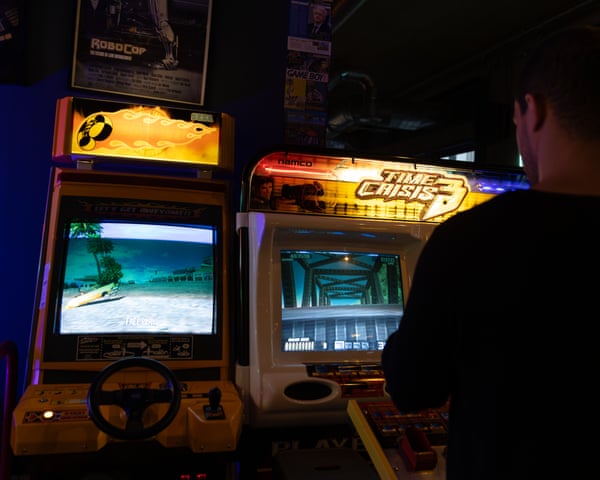
All of this points to one inevitable, socio-ludological phenomenon: the rebirth of the games arcade. Yes, I know there are brilliant retro arcades, and chain bars and cafes such as Continue and NQ64 offer classic coin-ops alongside themed cocktails. There’s also Arcade Arena, a new “immersive experience” venue in London that lets you play physical versions of Pac-Man and kart racers. But a growing number of players are interested in arcade-game design, and don’t necessarily want to play a few rounds of Time Crisis while downing a mojito.
What I’m hoping to see is a more refined take on the coin-op arcade, something akin to the rise of the independent bookshop, with carefully curated collections and interesting events.
This, I am pleased to discover, is happening. “The popularity of gaming bars and cafes is demonstrating that there is a sustainable business model in out-of-home gaming here in 2026,” says games journalist and arcade obsessive Will Freeman. “I wouldn’t go as far as to call it a boom, but there are a handful of smaller set-ups taking an approach that feels comparable to independent bookshops and record stores.”
He mentions NQ Japan, which is about to open in London’s Soho. “While it is a cafe, there’s a firm focus on imported Japanese coin-op cabinets – covering newer games and cult classics that carry weight in the arcade community,” he tells me. “It really looks to be serving an authentic, arcade experience, bringing back that anticipation of getting your hands on exotic games from the cultural centre of arcade gaming.”
|
 |
|
High-end joy … the arcade gaming industry is booming. Photograph: Teri Pengilley/The Guardian |
|
The retro gaming industry is booming, with specialist manufacturers such as Analogue and Evercade producing high-end consoles that play original carts or new emulated collections of rare and sought-after titles. People are willing to spend money on an authentic arcade-style experience, just as they are now spending money on DVDs and vinyl records. A growing number of us want to have experiences that mega corps can’t provide through sleek, glassy devices.
But while it is lovely that people are rediscovering foundational game mechanics through Ace Combat and Marvel Tōkon, there is much more to discover. The joy of arcades in the 1970s and 80s was that they were social hives as well as gaming spaces – you made friends, you learned from better players – and each game created its own community. Crucially, you went in with a handful of coins and could have a handful of very different experiences. A new era of boutique arcades could bring that back.
“Something is under way, even if it is quietly,” says Freeman, pointing to smaller independent arcades with curated games libraries, such as Pixel Bunker in Milton Keynes. “I think we might see more independent arcades open up that drop the established ‘gaming cafe’ model to various degrees, and bring that feeling of local experts who really know their arcade culture, and want to build venues that draw in enthusiast communities.”
Modern video games are bringing the arcade back into our homes. Perhaps now it is time to bring arcades back to our rapidly emptying high streets.
|
|