| | In this edition, the money machine behind data centers is starting to sputter, and a Wall Street tur͏ ͏ ͏ ͏ ͏ ͏ |
| |  | Business |  |
| |
|
 - BlackRock vs. Apollo
- OpenAI’s (double) agent
- AI’s electricity moment
- Valuemaxxing bonuses
 CoreWeave eyes insurers’ cash piles … Saudi Aramco attacked … BofA earnings clouded by $1.2B money-laundering fine … ASML hikes forecast |
|
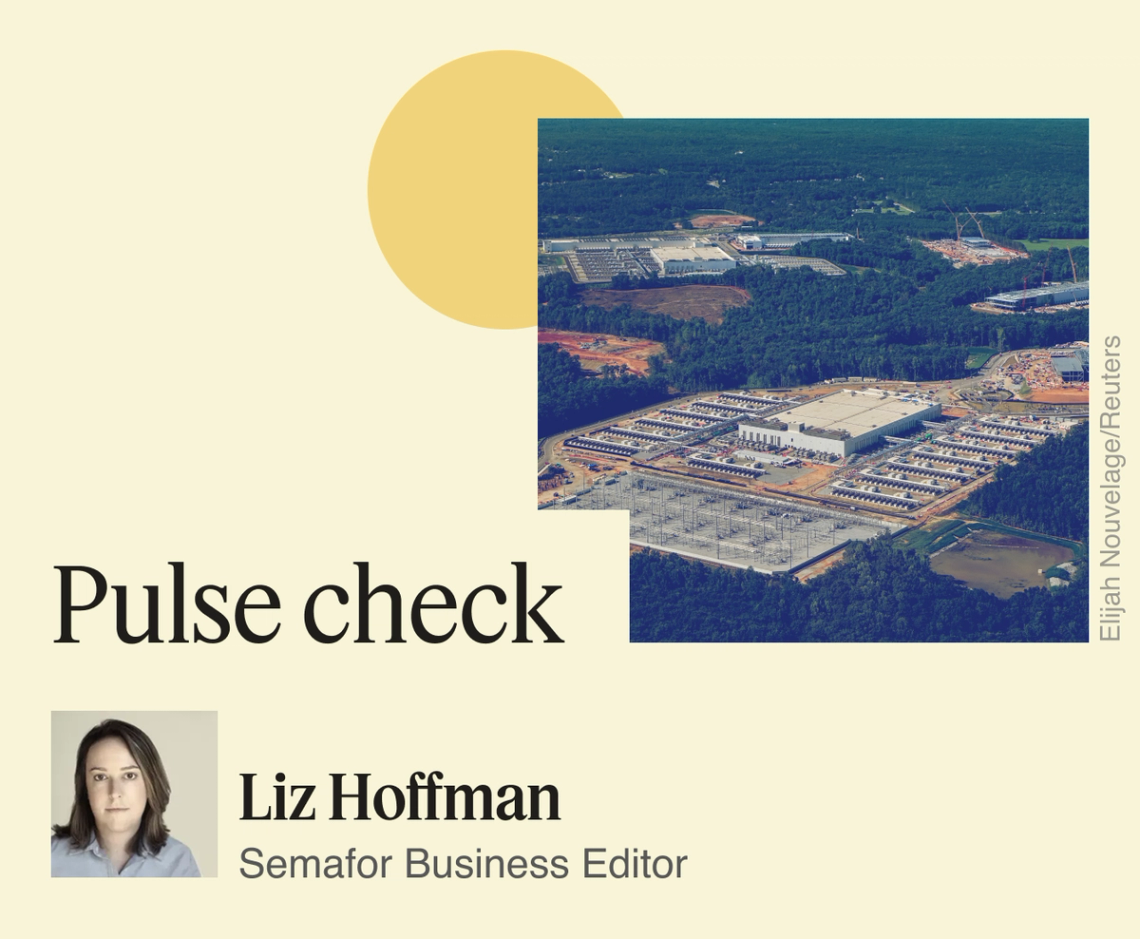 The money machine behind data centers is starting to sputter. When Volta, an AI infrastructure player launched all of eight months ago, began sounding out lenders this summer, a rubber stamp seemed in order. Anthropic’s promise to buy the compute from Volta’s data center in Norway was all investors would have needed a few months ago to get in line to buy the debt. They did not. That $5 billion debt deal is expected to price this week, but not without some pulled muscles, as my colleague Ellen DiMauro reported. Investors skittish about Volta’s scant track record and its reliance on Anthropic pushed Volta’s borrowing costs above 11%. Apollo provided a $1.5 billion security blanket. And in a sign of exactly whose creditworthiness really matters here, the interest rate charged to Volta hinges on Anthropic convincing Moody’s or S&P to give it a blue-chip rating. AI financing is already slowing down. Many of these data-center deals will still get done, but at higher rates and with more conditions attached. |
|
Debt battle: BlackRock vs. Apollo |
 Miho Uranaka, Carlo Allegri/Reuters Miho Uranaka, Carlo Allegri/ReutersA little-noticed deal this week for senior-care clinics is the first shot fired in a Wall Street turf battle. BlackRock’s HPS credit arm is essentially lending $2.8 billion to Humana, marking Larry Fink’s entry into a space that Apollo has had to itself until now. Apollo’s dryly named “capital solutions” business, launched in 2024, was a bet that asset managers could cosplay as banks. Their money could go places that banks’ deposit funding couldn’t, especially after post-2008 regulations. Apollo has since made big loans to companies including Intel and Keurig Dr Pepper, notching $800 million from the business last year on its way to a $1 billion target. Two years ago, I wagered that BlackRock and Apollo would be the winners of the weird debt world that limped, then sprinted, out of the global financial crisis. Apollo got there first, but BlackRock just threw its hat in the ring. — Liz Hoffman |
|
 Sam Altman during a Riyadh visit in May 2025. Brian Snyder/Reuters. Sam Altman during a Riyadh visit in May 2025. Brian Snyder/Reuters.AI agents, meet double agents. OpenAI said it identified, fired, and reported to the FBI an employee who bugged its office. The employee, a Saudi national later identified by law enforcement as Abdulrahman Alfozan, was arrested last week and charged with illegally recording company communication. (He appears to have some ties to members of the Saudi business elite.) Among the evidence against him: chatbot logs about how to install recording devices. Startup espionage has been pursued for far less (see: the Deel-Rippling drama over corporate HR software), but the FBI’s quick work and public rollout of the arrest shows how high the stakes are for the US government and frontier labs. The arrest comes days before the White House AI task force’s first meeting. Its chair, Jay Clayton, cited the case as proof the group is needed. — Rohan Goswami |
|
AI’s electricity metaphor |
 It will take companies “a decade or two” to figure out how to use AI, Ioannis Antonoglou, co-founder of Reflection AI, said on Semafor’s Future Proof. It’s a longer timeframe, laid out by someone incentivized to say the opposite, than competitors have suggested. Antonoglou sees AI like electricity: revolutionary, but hardly workflow-friendly. Industrial factory floors designed around central rotors powered by steam engines took years to remap to distributed power, connected to localized outlets. “What we need to do with AI is something similar,” said Antonoglou. That may be bad news for the profitability of model owners like Reflection, and its closed-source rivals OpenAI and Anthropic. But a slower adoption would make for a smoother transition for the economy. Chicago Fed President Austan Goolsbee is making the same bet, telling Semafor this week: “I would just, again, point folks to the history of general-purpose technologies. It takes a long time for those to work their way through the economy… We adjust.” |
|
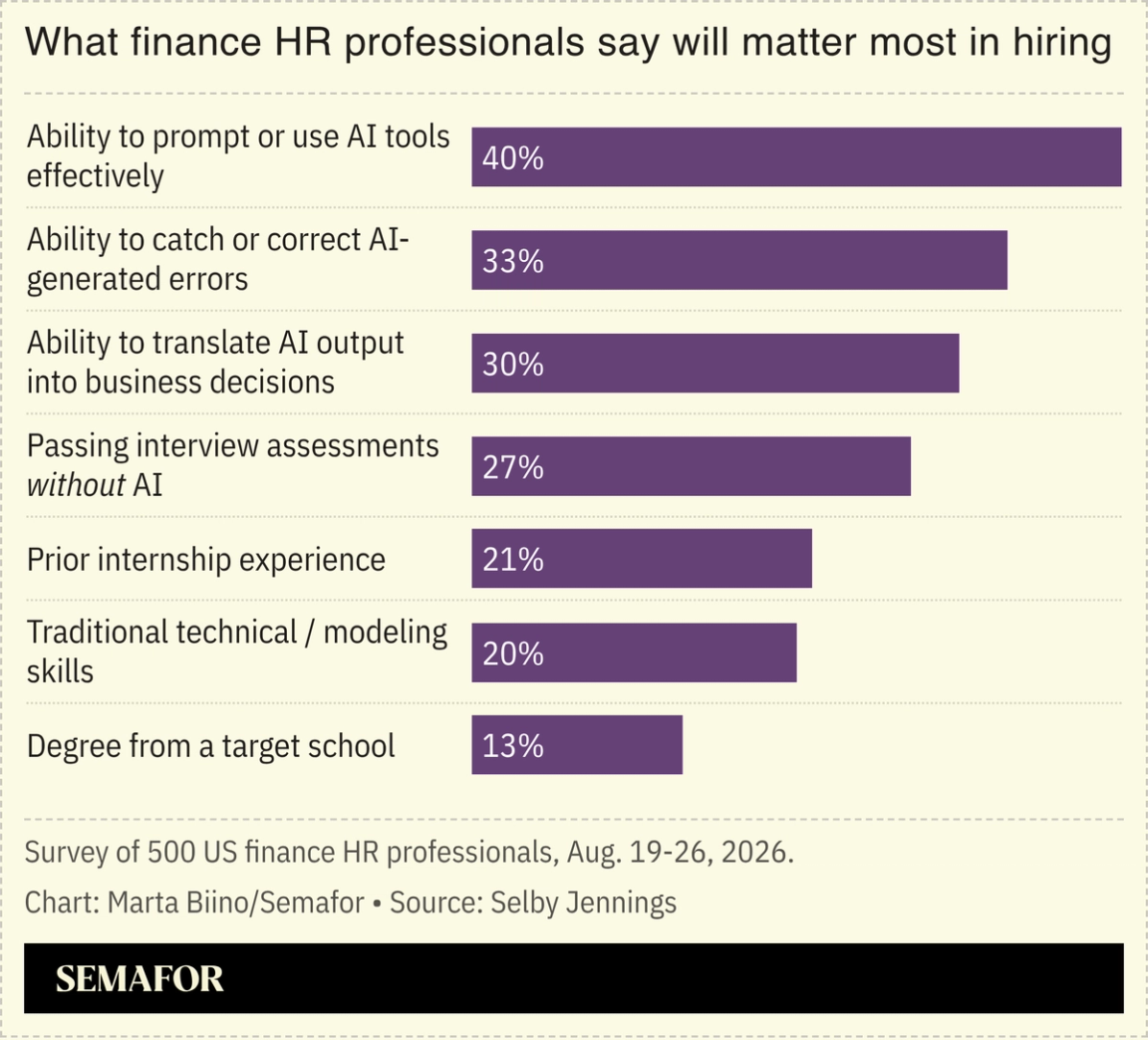 Tokenmaxxing may have been the shortest-lived corporate try-hard hustle in history, but many of Wall Street’s year-end bonuses still hinge on AI use. Applicants’ AI skills are nearly four times as important in hiring decisions as where they went to college, and a quarter of US financial firms have tied raises, promotions, and bonuses to AI proficiency, according to a survey of 500 companies by financial recruiting firm Selby Jennings. Breathe easy, bulge-bracketers: The practice is more common among fintech startups and smaller firms than brand-name banks and trading houses, Jacob Summers, Selby Jennings’ head of tech recruiting, told Semafor. Nearly a third of firms surveyed have created new roles or departments to track AI use, where total token burn is less important than wringing some actual value out of all the token use. (“Tokenmaxxing is dead, long live valuemaxxing,” proclaims an IBM blog post from June.) But in many organizations, monitoring that work falls to managers, turning them into part-time AI accountants. — Jake Angelo |
|
| Healthcare from Semafor Washington, DC |
 Behind closed doors, a new era of healthcare policy is taking shape. With US healthcare spending projected to hit $9 trillion annually by 2034, Medicaid cuts hanging in the balance ahead of the midterms, and increasing calls for regulation of clinical AI, the forces remaking healthcare policy are accelerating. Introducing Healthcare from Semafor Washington, DC, your weekly briefing on the politics, policy, and business driving the industry. Delivered on Thursday by David Lim, each edition will provide essential reporting and analysis on the forces reshaping healthcare, and what comes next. Sign up to receive the first edition this week. |
|
➚ BUY: Bees. Bumble, once worth $8 billion, gets rescued from its public-market stumbles with a $1.3 billion buyout. ➘ SELL: Knees. J&J is likely to spin off its joint-replacement device arm, which could be worth $20 billion. |
|
Anthropic is offering £145,000 salaries for personal assistants to help its London executives book travel, manage their calendars, and monitor email. If only there were a company with a powerful AI agent that could do all those things. |
|
| |