WHAT TO READ RIGHT NOW |
 Homes in a Box The year is 1918. Outside, the air is thick with woodsmoke and the low hum of cicadas. Inside, the icebox slowly drips into its metal pan. A thin film of flour lingers on the pine table from the day’s breadmaking. There’s no blue light of a smartphone to guide your evening; instead, you trim the wick of a kerosene lamp, watching the flame dance across the pages of your Sears, Roebuck and Co. catalog. | | |
 | SPONSORED CONTENT From fitness classes to waterfront walks, The Bay brings people together in ways that make it one place for all. Read More |
|
|
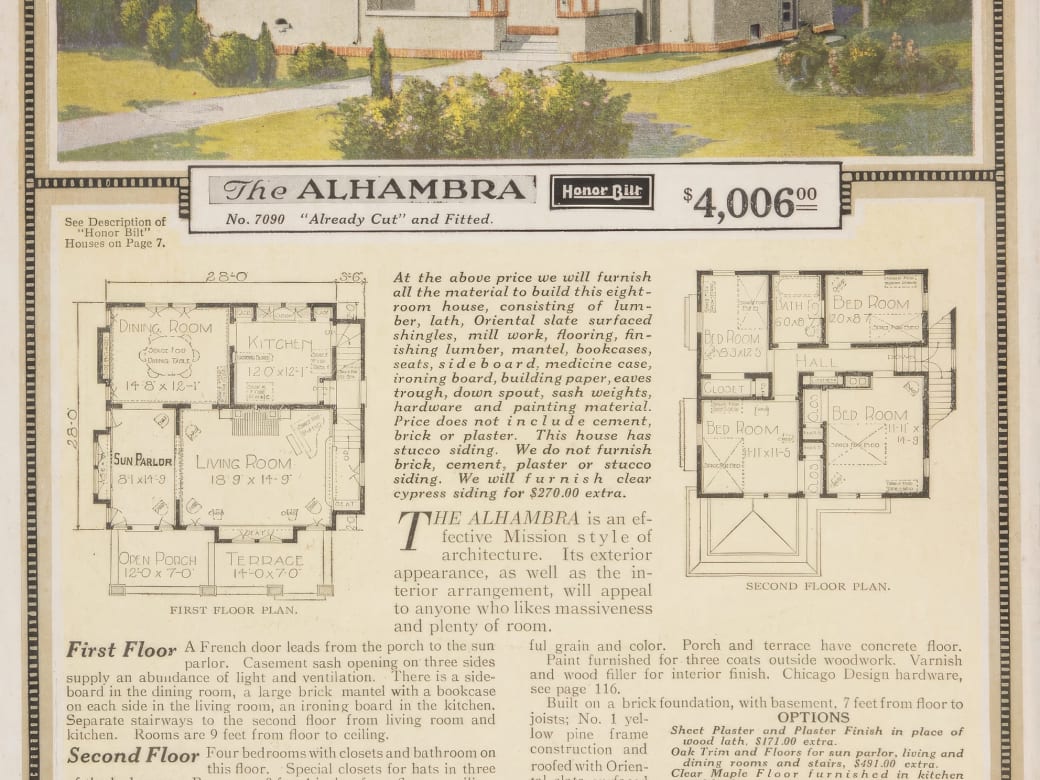
You’re part of the one-fifth of Americans with a subscription to the catalog, and between its covers are conveniences and luxuries you never knew you needed, everything from ostrich feathers and headstones to phonographs and hand-cranked washing machines. With a turn of the page, you’re faced with an offer that seems too good to be true. For as little as $1,000—roughly $21,000 today—you can purchase a pre-cut, ready-to-assemble home in more styles than you can imagine. You linger over designs like the Alhambra, a bungalow with a sunroom and Mission-style architectural details, like a low-pitched roof and decorative parapets, that match the Spanish-Mediterranean aesthetic popular in Florida at the time. The idea takes hold. You fill out the order form, and you wait. Weeks later, the stillness of the palmetto scrub is interrupted by the whistle of a train. When the boxcar doors slide open, it’s all there: thousands of pieces of framing lumber, stacks of cedar shakes, windows, doorknobs and nails. You haul the lumber and crates back by mule and wagon or the sputtering promise of a Model T. Piece by numbered piece, homeowners, contractors and builders set to work and, in less than 90 days, a house is standing where there was once only scrub and sand. |
 | Branded Content Making a Difference in Sarasota for More Than 25 Years Read More |
|
|
At the height of its popularity, Sears offered more than 400 home designs through its Modern Homes mail-order program. More than 70,000 kit homes, ranging from simple bungalows to massive colonials, were shipped across the country from 1908 to 1942. And Sears wasn’t the only one to do it—the pioneering Aladdin Company had begun offering pre-cut mail-order homes two years prior. By 1918, kit homes accounted for more than 2 percent of all homes in the country. Aladdin Company even began developing a community called “Aladdin City” southwest of Miami, and while the 1926 Miami hurricane and the collapse of the Florida land boom led to the venture’s dissolution, a number of the kit homes the company had put up stood until 1992, when the last of them suffered damage from Hurricane Andrew. Longtimers in Sarasota and Manatee counties have heard about these historic gems scattered throughout the area in real estate listings, news stories and by word of mouth. But the reality isn’t as straightforward as it seems. |
 | SPONSORED CONTENT Music Director Giancarlo Guerrero looks forward to reuniting with one of classical music’s superstars to deliver a supreme live concert experience for Sarasota audiences. Read More |
|
|
Definitive proof is rare. It’s not just our region that grapples with the challenge of historical overreach. Across the country, kit homes have been misidentified, overidentified or, in many cases, entirely imagined. Unless original documentation has survived or the structure reveals unmistakable physical evidence matching it to the original catalogs (and even this is not always trustworthy), authentication is frustratingly elusive because so many original kit designs were copied and sold by other companies, which went on to build look-alike conventional homes. Of the tens of thousands of Sears homes shipped in the early 20th century, only about 20 authentic Sears homes exist in Florida today. As a result of the challenges to attribution and the reliable contagion of the good old-fashioned rumor mill, houses become labeled as kits despite a lack of evidence. Often, this supposition ends up being shared with a local historical society or newspaper and spreads, reinforcing the story. Read More |
|
|  | | Homes in a Box The widespread stealing of designs by both lumberyards and kit home manufacturers means that even if a house looks nearly identical to one in a kit home catalog, it might not be. Read More |
|
|
| |
|