
|


 |
A little over a year ago, a bunch of people were worried that the AI data center boom would result in an epic bust, much like the railroad bust in 1873. I wrote about the possibility at the time:
 |
|
The basic idea is that even if AI is an incredibly useful technology and creates enormous economic growth in the future, the people building the infrastructure (data centers) might borrow so much money that they can’t pay it back in time. Last summer, the AI industry’s revenue was growing, but not nearly as fast as the amount of money being spent. But the “hyperscalers” building the data centers were mostly spending their own cash instead of borrowing money, so the danger wasn’t imminent. The worry was mostly about the future — if spending continued to increase and revenue didn’t accelerate, there could be an 1873-style bust.
Well, now it’s the future, and two things happened. Spending did accelerate, and hyperscalers started having to borrow money to keep increasing their spending. But revenue accelerated even more. The release of Claude Code, Codex, and other agentic coding tools proved to be the “killer app” of AI, and suddenly Anthropic and (to a lesser extent) OpenAI were rolling in cash:
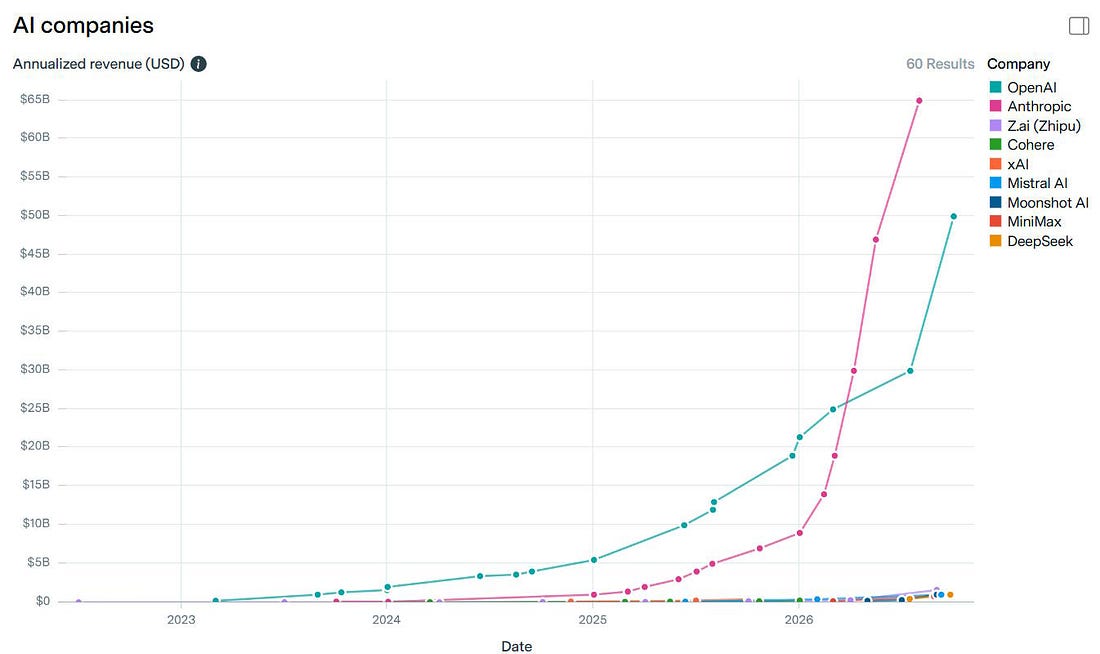 |
So like in summer 2025, we aren’t obviously heading for a big AI bust in the near future. But the stakes are higher now — because companies are borrowing a lot more money now, any slowdown in the torrid pace of AI revenue growth could cause a blowup.
The amounts of money being thrown around here are just staggering. A year and a half ago, the AI boom was still significantly smaller than the railroad boom of the late 1800s, as a percent of GDP. Now, there’s an active argument as to which one is bigger.
Which is bigger, AI or the railroads? (a pointless but fun debate)
This debate doesn’t really matter, because the basic message is just “Wow, it’s a lot of money.” But it’s fun to look at the numbers people are throwing around. Stijn Van Nieuwerburgh gives figures of 3.63% of GDP for AI and 2.24% of GDP for railroads: